
Rare Rudraksha from Nepal
The most collected rudraksh varieties in the Nepali tradition — Gauri Shankar (two beads naturally joined, read as Shiva and Parvati together), Trijuti (three so joined), Ganesh (with a natural trunk-like protrusion), Garbha Gauri, Savar, and the formless Nirakar. These are also the forms most often faked, so every rare bead is X-ray verified on request and carries a lifetime authenticity guarantee.
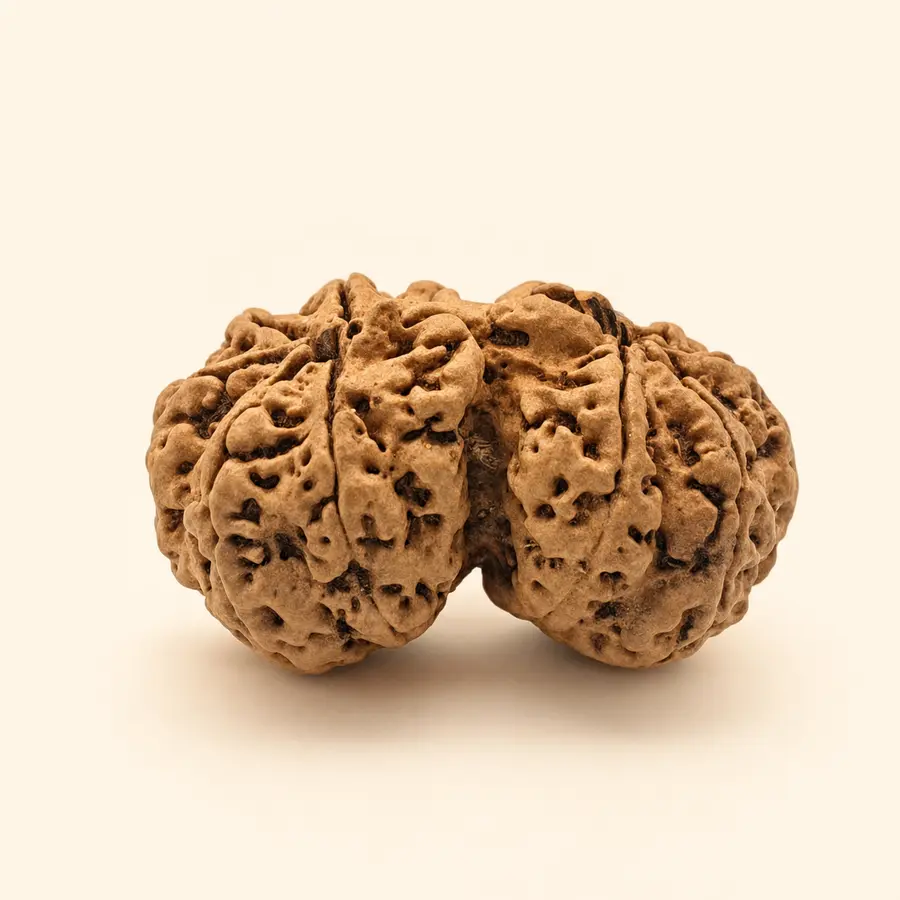
Why the rare forms are the ones worth verifying
A Gauri Shankar is two rudraksha grown naturally joined at the body — the tradition reads the pair as Shiva and Parvati together, which is where the name comes from. A Trijuti is three so joined, and it is genuinely uncommon. A Ganesh rudraksha carries a natural trunk-like protrusion on its face. Savar is a smaller bead fused to a larger one; Nirakar has no clefts at all, formless, and the name says so.
These are the forms most worth owning and, for exactly that reason, the forms most worth checking. Joined beads can be glued. Trunks can be carved. A convincing Gauri Shankar fake takes an afternoon and sells for years. This is not a reason to avoid rare rudraksh — it is a reason to buy only where the seller will put the piece under an X-ray with you watching.
We photograph every rare bead in hand before payment and X-ray on request, which on a joined form shows immediately whether the two seeds share a natural junction or meet at an adhesive line. An independent laboratory X-ray with a written certificate can be added as a paid extra, quoted with the bead. Every bead we sell carries a lifetime authenticity guarantee: if a piece ever fails third-party authenticity testing, we refund it in full, with no time limit on that promise.
Prices on rare forms move with the season and with what the sorting table actually turned up, so several are quoted per piece rather than listed. Ask and we will send photographs of what exists today, with the rupee figure alongside the dollar one.
How the X-ray reads a joined bead, and what a certificate does and does not prove, is explained on authenticity. Ordinary mukhi counts from one to twenty-seven are on the main rudraksha page.
Read before you choose.
Questions about the rare forms
What is a Gauri Shankar rudraksha?
Two rudraksha beads grown naturally fused into one body. The tradition reads the joined pair as Shiva and Parvati together — Gauri Shankar — and it is traditionally kept in the home shrine or worn as a single pendant rather than strung into a mala. Natural fusion is the whole point of the bead, which is why the glued imitation is so common.
How can I tell a real Gauri Shankar from a glued one?
Not reliably by eye, and not by any of the water or coin tests. An X-ray settles it: a naturally joined pair shows continuous internal structure across the junction, while a glued pair shows two separate seeds meeting at a line. We will X-ray any joined bead before you pay for it, and add an independent laboratory certificate — a paid extra, quoted before you commit — if you want the finding in writing from someone who is not us.
What makes a Ganesh rudraksha different?
A natural protrusion on the face of the bead, read in the tradition as the trunk of Ganesha. It occurs on beads of various mukhi counts — the protrusion is the defining feature, not the number of clefts. Carved trunks exist and are easy to sell to someone shopping from a photograph, so ask for the bead in your hand on video before money moves.
What is a Nirakar rudraksha?
A rudraksha with no clefts on its surface at all. Nirakar means formless, and the bead is treated in the tradition as an image of the unmanifest. It is one of the scarcer things to come off a sorting table and is priced per piece.
Are rare rudraksh more powerful than ordinary ones?
The tradition assigns each form its own presiding association; it does not rank them on a single scale of power, and we are not going to invent one to raise a price. Rare forms are rare — that is a statement about supply, not about what a bead will do for you. The five mukhi remains the bead the tradition holds suitable for everyone.
Do rare beads ship to India?
Yes, tracked from Kathmandu, typically three to twelve days to any Indian address, with the price quoted in rupees as well as dollars on request. Rare pieces travel with their photographs and, where you have asked for one, the laboratory certificate. Payment settles on WhatsApp before dispatch — we cannot offer cash on delivery into India.
Not sure which one?
Message us on WhatsApp. We'll send you photos of what's in stock today and help you choose based on your intention. Reply within hours from Kathmandu.
Free WhatsApp consultation