Provenance
Rudraksha Farming in Nepal — The Arun Valley, the Harvest, and the People Who Do It
Almost everything written about rudraksha begins at the bead. This begins at the tree — the hillsides it grows on, the month the fruit comes down, and the people whose year is organised around it.
By Kathmandu Rudraksha · Published 17 May 2026
Where rudraksha is farmed in Nepal
Nepal’s rudraksha comes almost entirely from the eastern hills: the Arun and Tamur river systems, and above all the districts of Bhojpur, Khotang and Sankhuwasabha. Dhankuta, Terhathum and Panchthar carry trees too. This is hill country, not the Terai plains and not the high Himalaya — the belt sits in the middle band, on slopes that drain hard and stay humid through the monsoon.
Altitude is where a lot of writing about rudraksha goes vague, so it is worth being exact about two different things. Elaeocarpus ganitrus as a species tolerates a wide range, from a few hundred metres up to around two thousand. The eastern Nepali belt that supplies the trade sits at the upper end of that range, and the villages we buy from are in the higher part of it. A bead is not better because a number is higher; the altitude matters because of what comes with it — cool nights, a long ripening, and the slow growth that gives a bead its density and its deeply cut faces.
Almost none of this is farming in the sense of a plantation. The trees are old, often older than the houses beside them, and they stand in and around the fields rather than in rows. A family’s rudraksha trees are inherited property, counted and divided like land.
When is rudraksha harvested in Nepal?
The fruit ripens after the monsoon. Through August and September the green fruit turns the deep blue that gives the tree its English name, the blueberry beech, and begins to drop. Collection runs from around late August into the autumn festival weeks — Dashain and Tihar — which is also when the hills have the labour to spare and when the household needs the cash.
That timing is why the trade has one buying season and eleven months of inventory. A bead offered in March came down from a tree the previous autumn. Anyone selling you a “fresh” bead in spring is describing storage, not harvest.
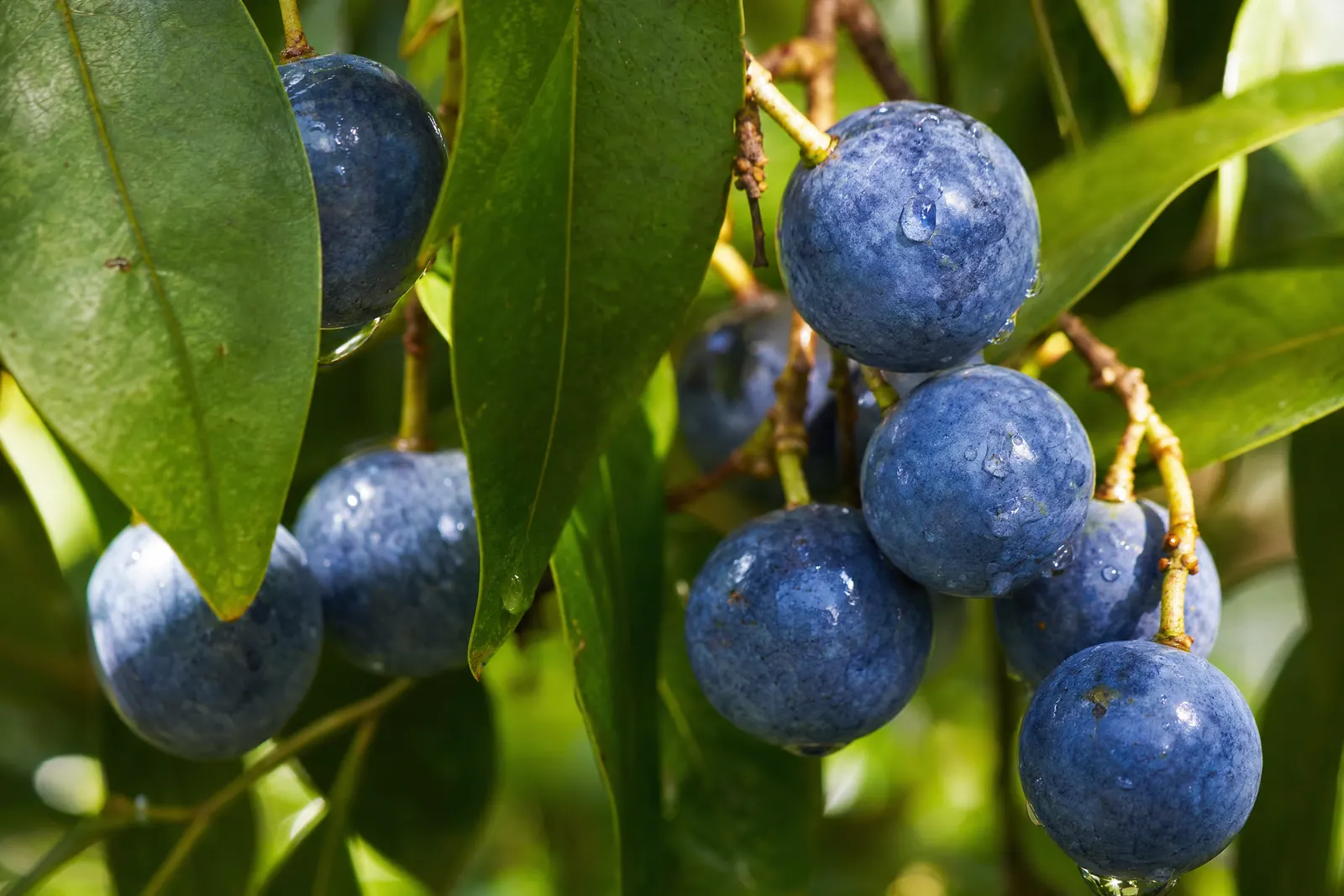
The fruit is gathered from the ground as much as picked. The blue flesh is then soaked and rubbed off — the least romantic part of the whole process, and the part that stains hands for a week — and the seed underneath is washed and dried in shade. Shade, not sun: drying too fast splits the bead across its faces and turns a saleable seed into firewood.
How a sack becomes grades
What leaves a village is a sack of mixed seed. What the trade buys is grades, and the distance between those two things is entirely hand labour.
Sorting happens in rounds. The first pass is size, because size sets the price band before anything else is considered. The second is the face count — the mukhi — read by tracing the natural lines from the top of the bead to the bottom with a thumbnail. The overwhelming majority of any sack is five mukhi; that is simply what the tree produces. Four, six and seven turn up steadily. Anything at one, two or three, and anything above fourteen, is rare enough that a sorter will stop and set it aside rather than drop it in a pile.
The third pass is condition, and it is the one buyers never think about: broken faces, insect holes, splits from fast drying, beads that dried misshapen. A bead can be a genuine, high-count Nepali rudraksha and still be worth very little because it cracked in October.
| Sorting pass | What is being judged | Why it decides the price |
|---|---|---|
| Size | Diameter in millimetres, graded in bands | Sets the price band before anything else; large beads of any mukhi are scarce |
| Mukhi | Natural faces traced top to bottom | Five mukhi is the bulk of every sack; rare counts are picked out individually |
| Condition | Splits, insect damage, broken faces, drying faults | A genuine bead that cracked while drying is worth a fraction of an intact one |
| Form | Joined beads, unusual shapes — Gauri Shankar, Trijuti, Ganesh | Found by eye, a handful per sack at best, and never predictable |
What the grower actually gets
This is the part of the chain that is almost never published, and the honest answer has two halves.
The first half is structural, and it is the reason this shop exists. In the usual route a household sells a whole sack, unsorted, to a travelling collector, for a single price that has to account for the collector’s risk on everything in it. The rare beads in that sack — the ones that carry most of its real value — are found later, by someone else, and priced by someone else again. The grower who owns the tree is paid before anyone knows what the tree produced.
The second half is what we do differently and can be checked rather than claimed. Growers we buy from list their own beads, under their own names, and set their own price in rupees — not in dollars, because a dollar figure is the one number a farmer in Bhojpur cannot sanity-check. Those listings are visible on this site: the beads on <a href="/new-harvest-rudraksha">this season’s harvest</a> page carry the name of the grower who sent them. Payment goes to that person.
We have deliberately not printed a table of what growers were paid per kilo this season. Those are real people’s incomes, the figures move with size and count and condition, and a single average would flatter us and mislead you.
Chemicals, polishing and what nobody tests for
Rudraksha reaches the market in a range of conditions, and the trade is not always frank about it. Beads are commonly oiled or polished to deepen colour and smooth the surface. Some are dyed. At the far end, seeds of other species are carved into convincing faces and sold as rudraksha — which is a different problem, and one worth <a href="/blog/how-to-identify-real-rudraksha">reading about separately</a>.
What we can say about ours: the beads are cleaned and shade-dried, and are not polished or oiled before they are photographed. What we cannot say is that they have been tested for surface treatment, because they have not — no routine test for that exists in this trade, and we are not going to invent one. The optional independent X-ray, which a buyer can request on any bead, images the internal chambers to corroborate the face count. It says nothing about what is on the outside.
If a seller tells you every bead is laboratory-certified, ask what the certificate actually tested. In most cases the answer is the chamber count, which is the one thing an X-ray can genuinely show.
Why any of this should matter to a buyer
Provenance is not a marketing word here, it is the only defence a buyer has. A bead carries no serial number and no maker’s mark. Once it leaves the hill it is indistinguishable from an Indonesian bead of the same size, and the difference in price between the two is large enough to make misdescription worth someone’s while.
So the questions worth asking a seller are dull and specific. Which district. Which month it came down. Who sorted it, and who was paid. Whether you can see the actual bead before you pay, rather than a photograph of a bead like it. A shop that buys direct can answer all four; a shop buying graded lots from a wholesaler generally cannot answer the first two.
If you want to see the chain rather than read about it, <a href="/new-harvest-rudraksha">this season’s beads</a> are listed with the grower’s name against each one, and <a href="/about">the atelier page</a> explains how the rest of it works.
Frequently asked questions
Where is rudraksha farmed in Nepal?
Mainly in the eastern hills — the Arun and Tamur valleys, above all the districts of Bhojpur, Khotang and Sankhuwasabha, with trees also in Dhankuta, Terhathum and Panchthar. The species grows from a few hundred metres up to around two thousand, and the belt that supplies the trade sits at the upper end of that range. Most trees stand in and around family fields rather than in plantations.
When is rudraksha harvested in Nepal?
After the monsoon. The fruit turns deep blue through August and September and comes down from around late August into the Dashain and Tihar festival weeks. There is one harvest a year, so a bead bought in spring was collected the previous autumn.
How long does a rudraksha tree take to fruit?
A seedling takes several years to come into bearing, and the trees that supply the trade are typically decades old — often older than the houses beside them. They are inherited property, counted and divided like land, which is why rudraksha is rarely planted as a cash crop.
Are Nepali rudraksha beads treated or polished?
Beads in the trade are commonly oiled or polished to deepen colour, and some are dyed. Ours are cleaned and shade-dried, and are not polished or oiled before they are photographed. We do not test for surface treatment and do not claim to — the optional independent X-ray, available on request, images the internal chambers to corroborate the face count, and says nothing about the surface.
What is the grower paid for rudraksha?
In the usual route a household sells a whole unsorted sack to a collector for one price, before anyone knows which rare beads it contains. Growers we buy from instead list their own beads under their own names and set their own price in rupees, and are paid directly. We do not publish per-kilo averages: the figures move with size, count and condition, and a single number would mislead.
Where to go next
- This season’s harvest
- How to identify real rudraksha
- About the atelier
- Can I Wear Rudraksha While Sleeping, Bathing,…
Keep reading
- The Rudraksha Tree and Its Seed — How the Bead Actually Forms
- The Rudraksha Jabala Upanishad: What the Text Actually Says About the Bead
- Rudraksha Benefits — What the Tradition Holds, and What Science Actually Says
- The Blue Fruit: What a Rudraksha Looks Like Before It Is a Bead
- Shravan 2026 — Dates, Every Somvar Monday, and How to Keep the Month of Shiva
- Maha Shivaratri: Keeping the Night, and the Bead