16 Mukhi Rudraksha Benefits — Power, Who Should Wear It, and How
The sixteen-faced Rudraksha, solah mukhi in Hindi, in the tradition's own terms — Mahamrityunjaya — Shiva, conqueror of death — with wearing rules, rashi suitability, and no promises we cannot keep.
16 Mukhi Rudraksha at a glance
In the tradition, the 16 Mukhi Rudraksha is the bead of Mahamrityunjaya — Shiva, conqueror of death, worn for freedom from fear, protection of the household and those one loves, and victory (Jai).
- Presiding deity
- Mahamrityunjaya — Shiva, conqueror of death (महामृत्युञ्जय)
- Ruling planet (graha)
- Not assigned in the sources we cite
- Traditionally worn for
- Freedom from fear, protection of the household and those one loves, and victory (Jai)
- Traditionally worn by
- Households seeking protection, and by those who live close to fear and wish to be free of it.
- Mantra
- ॐ नमः शिवाय (Om Namah Shivaya), the mantra for every Rudraksha
- Who can wear it
- Anyone — men, women and children of any background
Traditional association as the texts and living practice hand it down — not a medical claim or a promised outcome.
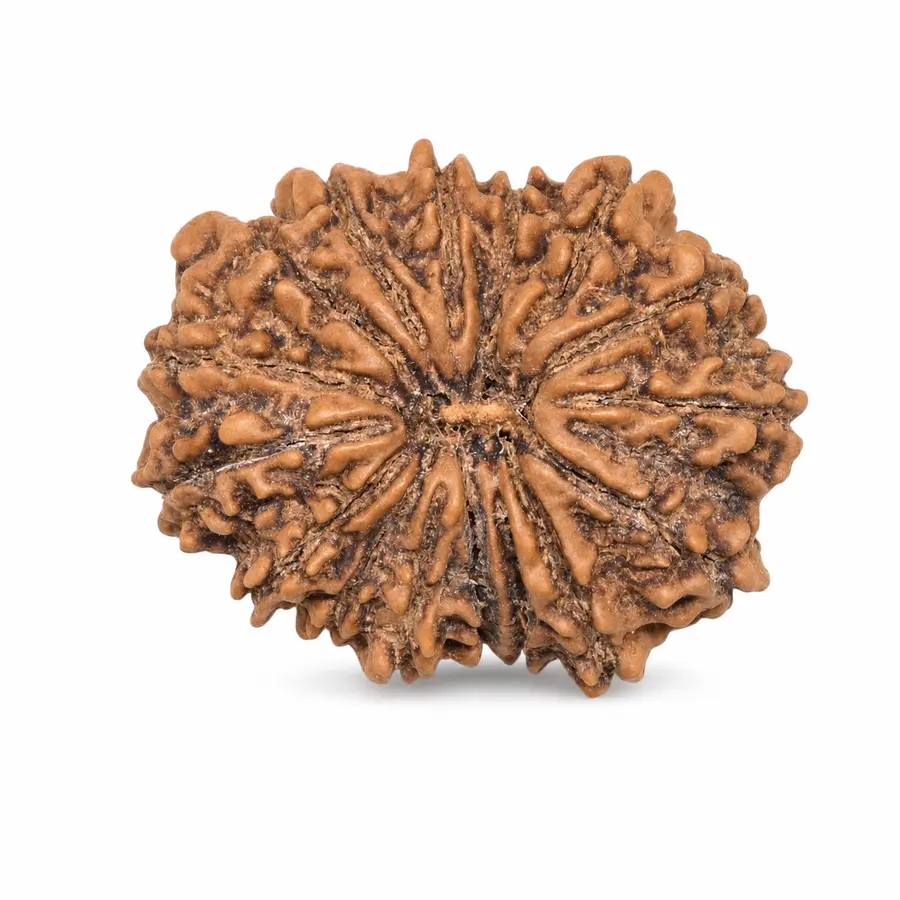
Benefits of the 16 Mukhi Rudraksha
- Freedom from fear: Named Jai, victory: the bead carries the Mahamrityunjaya current, Shiva who unbinds from fear and untimely ending.
- Protection of the household: Kept in the home as much as worn, a guardian of what one loves.
- Health — the honest answer: The tradition speaks of the 16 Mukhi in terms of freedom from fear, not cures. A rudraksha is a dried seed with no documented physiological effect, so it is never a treatment for any illness.
The power of the 16 Mukhi, as the tradition describes it
Sixteen faces, and the tradition names it Jai — victory. This bead carries the Mahamrityunjaya current: Shiva as the one who unbinds from fear and untimely ending. It is classically kept in the home as much as worn, a guardian of the household.
Where the texts speak of it, the theme is constant: freedom from fear, protection of what one loves.
Its presiding form is Mahamrityunjaya — Shiva, conqueror of death (महामृत्युञ्जय). Everything on this page is traditional association as the texts and living practice hand it down — not a medical claim, not a promised outcome, and not a substitute for anything you would otherwise do for your health.
Who wears the 16 Mukhi
Traditionally kept by households seeking protection, and by those who live close to fear and wish to be free of it.
No one is excluded from Rudraksha: men, women, and children of any background may wear it. Traditional affinity is a pointer, never a gate. If this is your first bead and the 16 Mukhi does not feel settled in your hand, the 5 Mukhi is the tradition's universal answer and always will be.
Wearing the 16 Mukhi, and its mantra
String it on natural thread, or cap it in silver or gold and hang it from a chain. Keep it from soap and knocks, oil it now and then, and expect it to darken with the years. The mantra is the one that serves every Rudraksha, ॐ नमः शिवाय (oṁ namaḥ śivāya); we do not print per-bead beej syllables, because the published lists disagree and none can be traced to a source we could cite (the rudraksha mantra, and why). Rules on days, food and sleep differ between families: follow your own. The full answers are in how to wear Rudraksha and can I wear Rudraksha while sleeping, bathing or eating non-veg.
Rashi and graha suitability
This bead is not assigned to one of the nine grahas in the sources we would be willing to cite, so we make no rashi claim for it.
If you do not know your rashi, our rashi finder calculates it from your birth date in your own browser — nothing is uploaded, nothing stored. And a caution we would rather give than withhold: choosing by chart is one of three traditional doors, alongside choosing by intention and simply asking someone who handles beads daily. A full reading belongs to a jyotishi with your whole chart, not to a bead shop.
Side effects — the honest answer
A Rudraksha is a dried seed on a thread, with no documented physiological effect, so it has nothing we would call a side effect. What can happen is ordinary: a metal cap irritating a nickel-sensitive wearer, a tight thread, a cracked bead scratching. Anyone who says a bead will harm you on the wrong day is selling something. More in Rudraksha side effects.
How to check a 16 Mukhi Rudraksha is original
Start with the count itself: a genuine 16 Mukhi carries 16 continuous grooves running unbroken from one pole of the bead to the other — natural valleys the surface grain flows around, not cuts that interrupt it. Count at both ends, because the poles are where a faked line struggles most to converge cleanly.
Above fourteen faces genuine stones are scarce, prices rise steeply, and carving fraud concentrates exactly where the money is. Before you pay rarity prices — anyone’s, including ours — ask for close photographs and video of the exact bead, both poles included: every genuine line runs unbroken and converges at the poles, a carved one cuts across the grain, and a joined bead shows its seam. And hold the price floor: a high count offered at an ordinary price is not a discount.
None of this needs folklore. The famous water test proves nothing either way; how a seed sinks depends on its age and oiling, not its honesty. And a certificate is only as trustworthy as its issuer, so verify the bead, never the PDF. The full method, fake by fake, is in our identification guide — and our own answer at every count is the same: photographs and video of your exact bead before you pay if you ask, so verification can happen before the money moves, and our lifetime authenticity guarantee after it.
The 16 Mukhi compared with the counts people weigh it against
The 16 Mukhi is the bead of Mahamrityunjaya — Shiva, conqueror of death; it is worn for freedom from fear, and for protection of the household and those one loves. Beside it:
- 5 Mukhi: Kalagni Rudra — Shiva as the fire of time, under Brihaspati; worn for calm and general wellbeing, and for steadying the mind for daily practice.
- 15 Mukhi: Pashupatinath — Shiva as lord of all beings; worn for compassion, and for the work of care and healing.
- 17 Mukhi: Katyayani and Vishwakarma, the divine architect; worn for building wealth in its widest sense, and for raising something large and lasting.
The tradition does not rank the counts against one another: each answers a different intention, and many people wear two together. If none of them is clearly yours, the 5 Mukhi is the one held suitable for everyone. The wearing combinations guide sets out the pairs the tradition names.
16 मुखी रुद्राक्ष के फायदे — हिंदी में
16 मुखी रुद्राक्ष (सोलह मुखी) का संबंध महामृत्युञ्जय से माना जाता है। इसके लाभ और इसकी शक्ति को परंपरा इसी संबंध से समझती है। परंपरा में इसे रक्षा चाहने वाले परिवार रखते हैं, और वे लोग जो भय के निकट रहते हैं और उससे मुक्त होना चाहते हैं। ये परंपरागत मान्यताएँ हैं — कोई चिकित्सीय दावा या पक्का परिणाम नहीं।
कौन पहन सकता है: कोई भी — स्त्री, पुरुष और बच्चे, बिना किसी दीक्षा के। कैसे पहनें: रेशम, सूती या ऊनी धागे में, या चाँदी या सोने में; साबुन और शैम्पू से दूर रखें, और कभी-कभी सरसों या बादाम का तेल लगाकर छाँव में सुखाएँ। मंत्र: ॐ नमः शिवाय। रुद्राक्ष एक सूखा बीज है, इसलिए इसका कोई प्रमाणित दुष्प्रभाव नहीं है।
असली की पहचान: इसकी सभी 16 रेखाएँ एक छोर से दूसरे छोर तक बिना टूटे जानी चाहिए। पानी वाला परीक्षण कुछ सिद्ध नहीं करता। इस दुर्लभता के दाने की कीमत हर दाने के अनुसार अलग बताई जाती है। भुगतान से पहले हम आपके उसी दाने की फोटो और वीडियो भेजते हैं।
Questions people ask
What are the benefits of the 16 Mukhi Rudraksha?
In the tradition, the 16 Mukhi Rudraksha is the bead of Mahamrityunjaya — Shiva, conqueror of death, worn for freedom from fear, protection of the household and those one loves, and victory (Jai). These are traditional associations, not medical claims or promised outcomes.
Who should wear the 16 Mukhi Rudraksha, and can anyone wear it?
Traditionally kept by households seeking protection, and by those who live close to fear and wish to be free of it. No one is excluded from Rudraksha, and traditional affinity is a pointer rather than a rule. If in doubt, the 5 Mukhi is held suitable for everyone.
Who should not wear the 16 Mukhi Rudraksha?
No one is barred from the 16 Mukhi. The cautions the tradition asks of every wearer are the same for every count: take it off at a cremation ground and during intimacy, and do not lend a bead you have worn. Be wary of anyone who says a bead will harm you unless you pay for a remedy.
Which god and ruling planet belong to the 16 Mukhi Rudraksha?
Its presiding form is Mahamrityunjaya — Shiva, conqueror of death (महामृत्युञ्जय). The sources we would cite assign it no single ruling planet. These are the associations the texts and living practice hand down.
Which rashi suits the 16 Mukhi Rudraksha?
We make no rashi claim for this bead, because the sources we would be willing to cite do not assign it to one of the nine grahas.
How do I check that a 16 Mukhi Rudraksha is original?
Count the 16 grooves: each must run unbroken from pole to pole as a natural valley the surface grain flows around, not a cut that interrupts it. Count at both poles, where a faked line struggles most to converge cleanly. The water test proves nothing either way. Ask, and we photograph and film the exact bead before payment, so you can count it yourself.
Which day and which hand should I wear the 16 Mukhi Rudraksha on?
Many people put on a new Rudraksha on a Monday, Shiva's day, after a bath, saying ॐ नमः शिवाय. The texts make no day or hand compulsory: at the chest as a pendant, on the wrist or on the arm all count. If your family has its own custom, follow that.
What are the benefits of the 16 Mukhi Rudraksha for women and for men?
The same for both. The 16 Mukhi carries one set of traditional associations for everyone — freedom from fear, protection of the household and those one loves, and victory (Jai) — and women and men wear it the same way, with no initiation and nobody's permission. Some families keep their own customs, such as removing beads at particular times; those are yours to follow if you have them.
Is there a 16 Mukhi Rudraksha mala or bracelet?
The 16 Mukhi is too rare to string as a mala: it is kept and worn as a single bead.
Can I wear the 16 Mukhi with other Rudraksha?
Yes. Beads of different counts are traditionally worn together — the 5 Mukhi beside any other is the commonest pairing, and the siddha mala strings one of every count from 1 to 14. Our guide to Rudraksha wearing combinations sets out the classical pairs.
How much does a 16 Mukhi Rudraksha cost?
For orders from outside India and Nepal, a genuine Nepali 16 Mukhi from us starts at $893, rising with size; every size's price is on its page, with $40 shipping once per order. In Nepal our rupee price guide starts at NPR 112,000 for a regular-size bead; in India we quote the local price on request. Ask, and we photograph your exact bead before you pay.