Care
How to Wear Rudraksha — Rules, First-Wearing Ritual, and Care
Which day to begin, a simple first-wearing ritual, neck or wrist, daily usage, and the rules that matter — explained without fear or superstition.
By Kathmandu Rudraksha · Published 16 May 2026 · Updated 10 August 2026
Last reviewed: August 2026 · Kathmandu Rudraksha
Wearing it for the first time — a simple home ritual
You do not need a priest, a temple, or fluent Sanskrit to begin. Tradition asks for cleanliness, respect, and intention; the rest is detail. The morning of a Monday — Shiva’s day — is the classical choice, and the month of Shravan or the night of Shivaratri are held especially auspicious, but no day is wrong for a sincere beginning.
- Bathe and put on clean clothes. Choose a quiet, clean spot — your altar if you keep one — and sit facing east.
- Place the Rudraksha on a clean plate or cloth. Sprinkle it with a little clean water (Ganga jal if you have it), then pat it dry — this is a blessing, not a bath.
- If you wish, touch a little sandalwood paste to the bead and pass it briefly through incense smoke.
- Hold the bead or mala in your right hand at your heart and chant Om Namah Shivaya — eleven times at minimum, one hundred and eight if you can sit for it — holding your intention for wearing it.
- Touch the bead to your forehead, then put it on. It is done.
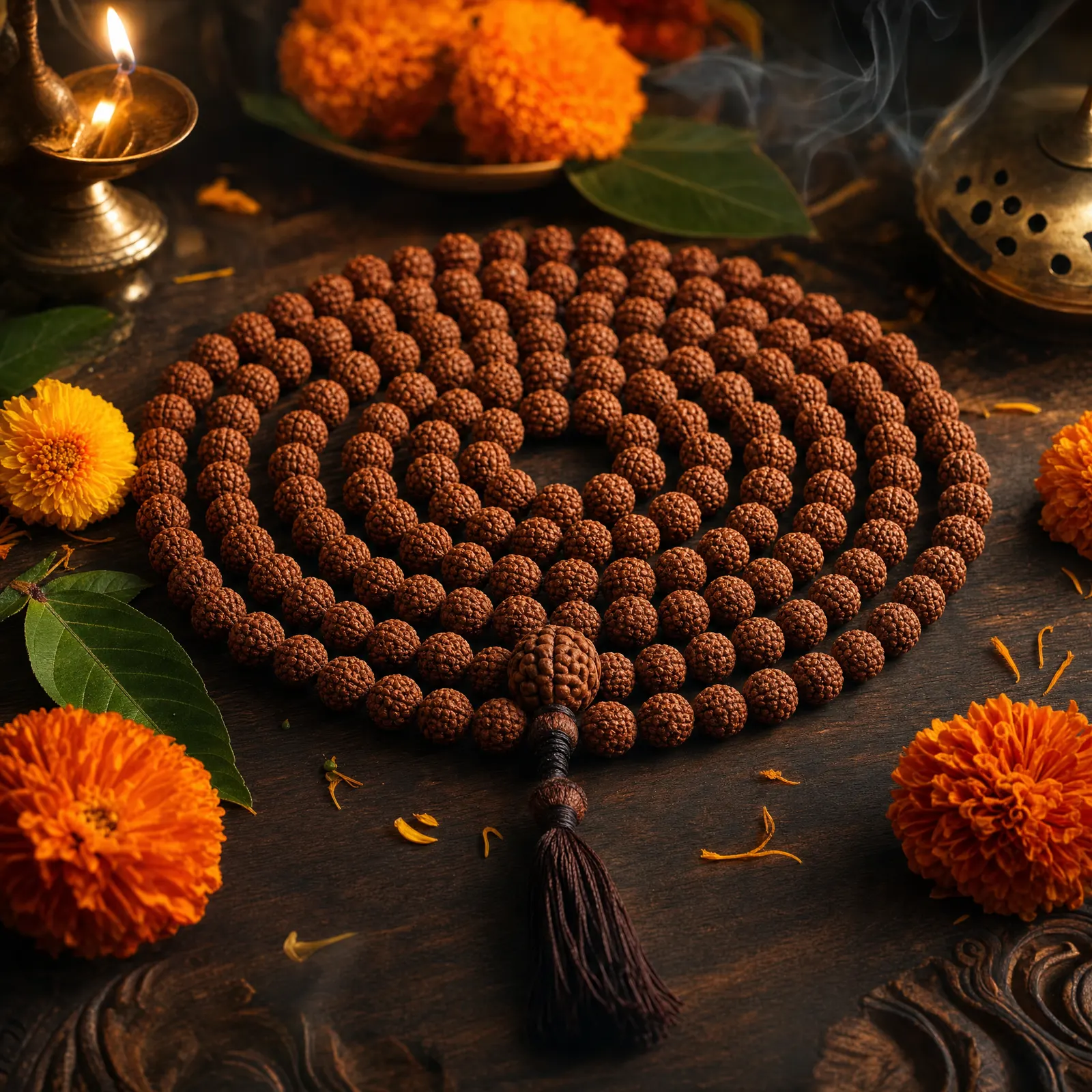
If your bead came from us with prana pratishtha performed at Pashupatinath, the formal consecration has already been carried out by priests at the temple; the ritual above is your personal welcome, not a requirement. Repeat it whenever the mala has been off your body for a long while.
Where to wear it — neck, wrist, or altar
At the neck
The classical placement is at the neck, with the beads resting against the skin at heart height — strung on red or yellow cotton or silk, or capped in silver or gold. Choose a length that lets the beads sit below the collarbone rather than riding at the throat; a pendant-style single bead follows the same rule. Worn over clothing, the bead is not “wasted” — skin contact is the tradition’s preference, not a switch that turns the bead on or off.
At the wrist
A bracelet is a perfectly traditional way to keep Rudraksha on the body — practical for working hands, and the usual home of the 5 Mukhi and mixed-mukhi Rudra bands. Some lineages favour the right wrist, the side of action, for beads of resolve like the 6 Mukhi; both wrists are accepted everywhere.
On the altar
Not every Rudraksha is meant for the body. The rarest beads — Ek Mukhi above all — are traditionally kept on the altar and worshipped rather than worn. A japa mala used for counting mantra is often kept unworn in its pouch, reserved for practice alone; and when counting, tradition turns back at the bindu (the guru bead) rather than crossing over it.
The rules — what is firm, and what is lineage
Ask ten teachers for the rules of wearing Rudraksha and you will receive ten overlapping lists. The overlap is what matters.
Widely shared across traditions
- Keep the beads clean, and treat them as sacred objects rather than jewellery.
- Remove them before visiting a cremation ground or attending last rites.
- Remove them during physical intimacy.
- Do not lend your worn beads to others — a Rudraksha is considered personal once worn.
- Keep chemical perfumes and sprays off the beads — which is care as much as custom.
Where lineages differ — follow your own
- Sleeping: many remove the mala at night and rest it by the bed or on the altar — which also keeps the beads dry — while others wear it always. Both positions are traditional.
- Menstruation: some traditions advise setting the beads aside during menstruation; many respected teachers see no need. The bead itself is never “spoiled” either way — follow your family tradition and your own comfort.
- Food and drink: some lineages ask for sattvic habits while wearing Rudraksha. The seed does not police your plate; the shared view is that sincerity of practice matters more than diet.
The Panchmukhi deserves a special word: the 5 Mukhi carries no restrictions beyond the shared list above. The tradition regards it as the universal bead — suitable for men, women, and children, in every stage of life.
One mantra is always correct
Om Namah Shivaya serves every Rudraksha, from the everyday 5 Mukhi to the rarest bead in a collection. Lineages do assign specific beej mantras to specific mukhi counts, but those assignments genuinely differ between texts and teachers — which is why we do not print a one-size-fits-all table. When your bead ships, ask us on WhatsApp and we will share the mantra our own lineage uses for it.
Wearing specific beads — 5, 6, 7, and 12 Mukhi
5 Mukhi (Panchmukhi)
The universal first bead — most begin with a 5 Mukhi Rudraksha, held sacred to Kalagni Rudra under Jupiter. Wear it at the neck or wrist from any Monday onward; a full 108-bead Panchmukhi mala is equally at home worn on the body or kept for japa. No special rules apply beyond the shared list above.
6 Mukhi
Kartikeya’s bead of resolve, under Venus. Living practice often places it on the right wrist — the side of action — though the neck is equally correct. Begin on a Monday with Om Namah Shivaya, and wear it into the work that needs your follow-through.
7 Mukhi
Mahalakshmi’s bead, under Saturn. It is worn at the neck like any other — and in living practice many householders also keep a separate 7 Mukhi in the cash box or place of business. If you do both, keep the worn bead and the kept bead distinct.
12 Mukhi
The Sun’s own bead, traditionally chosen by leaders and public people. It is worn at the neck, resting near the heart. Some lineages like to begin on a Sunday, the Sun’s day; a Monday beginning is never wrong.
Cleaning and oiling
- Wipe the beads occasionally with a soft, dry or lightly damp cloth. Avoid harsh soaps and detergents.
- Every few months, apply a tiny amount of a natural oil (such as sandalwood or a light unscented oil) with a soft brush to keep the beads from drying out and cracking.
- Let the beads dry naturally away from direct heat. Do not use a hairdryer or leave them on a hot surface.
What to avoid
- Prolonged soaking or repeated heavy water exposure, which can soften the seed over time.
- Chemical perfumes and alcohol-based sprays directly on the beads.
- Storing a wet mala in a sealed container, which can encourage mould.
A well-cared-for Rudraksha deepens in colour and character with age. The patina that builds up over years of wear is part of its beauty.
Frequently asked questions
How do I wear a Rudraksha mala at home for the first time?
Bathe, sit facing east in a clean spot, sprinkle the mala with clean water and pat it dry, offer sandalwood or incense if you wish, chant Om Namah Shivaya at least eleven times while holding your intention, touch the mala to your forehead, and put it on. A Monday morning is the classical day to begin — no priest or temple is required.
Which day is best to start wearing Rudraksha?
Monday, the day of Shiva, is the classical choice, and the month of Shravan and the night of Shivaratri are considered especially auspicious. No day is wrong for a sincere beginning.
Should Rudraksha be worn touching the skin at the neck?
Tradition prefers the beads against the skin at heart height when worn at the neck, strung so they sit below the collarbone. A bead worn over clothing or at the wrist is not wasted — skin contact is a preference of the tradition, not a requirement.
What are the rules for wearing a 5 Mukhi (Panchmukhi) Rudraksha?
The Panchmukhi carries no special restrictions. The shared rules that apply to every Rudraksha apply to it: keep it clean and treated with respect, remove it at cremation grounds and during intimacy, and do not lend a worn bead. Tradition holds the 5 Mukhi suitable for everyone, including children.
Do 6, 7, or 12 Mukhi Rudraksha have different wearing rules?
The ritual and rules are the same for every count; only the customs differ. The 6 Mukhi is often worn on the right wrist, the 7 Mukhi is sometimes additionally kept in the cash box in living practice, and some lineages begin a 12 Mukhi on a Sunday for the Sun. Om Namah Shivaya serves them all.
Can I wear Rudraksha while sleeping or bathing?
You can, but many people remove skin-worn beads to keep them dry, which helps extend their life. This is a matter of personal preference rather than a strict rule.
How do I clean a Rudraksha mala?
Wipe it with a soft, dry or lightly damp cloth and avoid harsh detergents. Every few months apply a small amount of natural oil with a soft brush, then let it dry naturally away from heat. You will sometimes see this care called “conditioning” the bead — same practice, different word.
Which hand should I wear a Rudraksha bracelet on?
Most traditions favour the right wrist — the hand of action and offering — but no rule is broken by the left. Consistency and respect matter more than the side: keep the beads touching the skin, and remove the bracelet before cremation grounds, as with any Rudraksha.
Does water damage Rudraksha?
Occasional contact is fine, but prolonged soaking or repeated heavy water exposure can soften the seed over time. Keep beads as dry as practical and never store a wet mala sealed.
Where to go next
- Japa Mala
- Bracelets
- Prana Pratishtha at Pashupatinath
- All Mukhi Rudraksha
- What to Do If You Lose Your Rudraksha
- 5 Mukhi Rudraksha
- 5 Mukhi Bracelet
Keep reading
- Rudraksha Bracelet: Types, Benefits & How to Choose
- Who Can Wear Rudraksha? Women, Children, Other Faiths — and Who Should Not
- How to Care for Your Rudraksha — The Complete Guide to Cleaning, Oiling & Storage
- Can I Wear Rudraksha While Sleeping, Bathing, Eating Non-Veg or on a Gold Chain? Question by Question
- How to Start a Daily Sadhana — A Simple 40-Day Practice
- What Beads Do Sadhus Wear? The Yogi’s Rudraksha, Explained