Foundations
What Is Rudraksha? The Sacred Seed, Plainly Explained
Rudraksha is a Himalayan seed held sacred as Shiva's tears — what it is, how mukhi work, and how to spot a real one, from the farmers who grow them.
By Kathmandu Rudraksha · Published 19 July 2026 · Updated 15 November 2026
Last reviewed: November 2026 · Kathmandu Rudraksha
The plain definition
A Rudraksha is the cleaned, dried stone of the fruit of Elaeocarpus ganitrus, a broadleaf evergreen tree of the Himalayan foothills and parts of Southeast Asia. The tree fruits a vivid blue berry; inside the flesh sits a hard, deeply ridged stone, divided inside into compartments that each hold a seed. In everyday speech the whole stone is called a seed, and that stone, cleaned and dried, is the bead. (Elaeocarpus ganitrus is the name the trade uses; botanical databases now treat it as a synonym of a wider species, and no single label is proven for every bead sold.) The Shaiva tradition of Hinduism holds Rudraksha sacred above all, wearing the beads on the body and stringing them into 108-bead malas for japa — the counted repetition of mantra, most universally Om Namah Shivaya — and they appear in Buddhist and Sikh practice as prayer beads too.
That is the whole object: a seed, unaltered, from a tree. Everything else — the deities, the counts, the prices, the folklore — is what tradition and trade have built around it.
In the market, this seed spans from the common, inexpensive five-faced bead to collector prices for the rare high counts — and because that range invites fraud, much of what is sold online as “Nepali rudraksha” is not. Everything below — the name, the legend, the mukhi system, and how a real bead is told from a fake — exists to make you unfoolable.
The name: Rudra and aksha
Rudraksha is a Sanskrit compound: Rudra — the fierce Vedic name of Shiva — joined to aksha, meaning eye, and in the living reading, tears. "The eye of Rudra"; "the tears of Shiva". The name is not decoration: it carries the origin story the texts tell, and it is why no serious tradition treats the bead as jewellery first.
The origin story the texts tell
In the account carried by the Shiva Purana and the Rudrakshajabala Upanishad, Shiva sat in meditation for an age — a thousand years of it, in the telling — and when his eyes opened, tears fell to the earth. Where they landed, the Rudraksha trees rose. The tradition is careful about what this story means: the bead is a token of Shiva’s compassion made touchable, a fragment of that long stillness you can hold in the hand. We tell it as the texts tell it — as sacred tradition, which needs no laboratory and claims none.
The texts themselves are specific. The Rudrākṣajābāla Upaniṣad — the scripture devoted entirely to this bead — frames its teaching as Kalagni Rudra answering the sage: the Lord closed his eyes in a thousand-year meditation before the destruction of Tripura, and the tears that fell to earth became the rudrākṣa; the text reads the bead’s base as Brahmā, its middle as Viṣṇu, its crown as Śiva. The Śiva Purāṇa devotes a chapter of the Vidyeśvara Saṁhitā — widely numbered twenty-five — to the bead’s glory, and the Devī Bhāgavata gives it a run of chapters in its eleventh book. Where manuscript numbering differs between editions, the attribution is traditional rather than settled, and we say so.
From blue fruit to brown bead
The trees fruit after the monsoon. In Nepal the serious harvest comes from the eastern hills — the Arun and Tamur valleys above all — where harvesters gather the fruit, strip away the blue flesh, and clean, dry, and sort the seeds by hand — in and around Dingla, in the hills of Bhojpur, where several of the same farming families who harvest our beads also knot our malas. Most of a harvest is the everyday 5 Mukhi; the rare counts surface a few beads at a time, which is the entire basis of Rudraksha pricing.
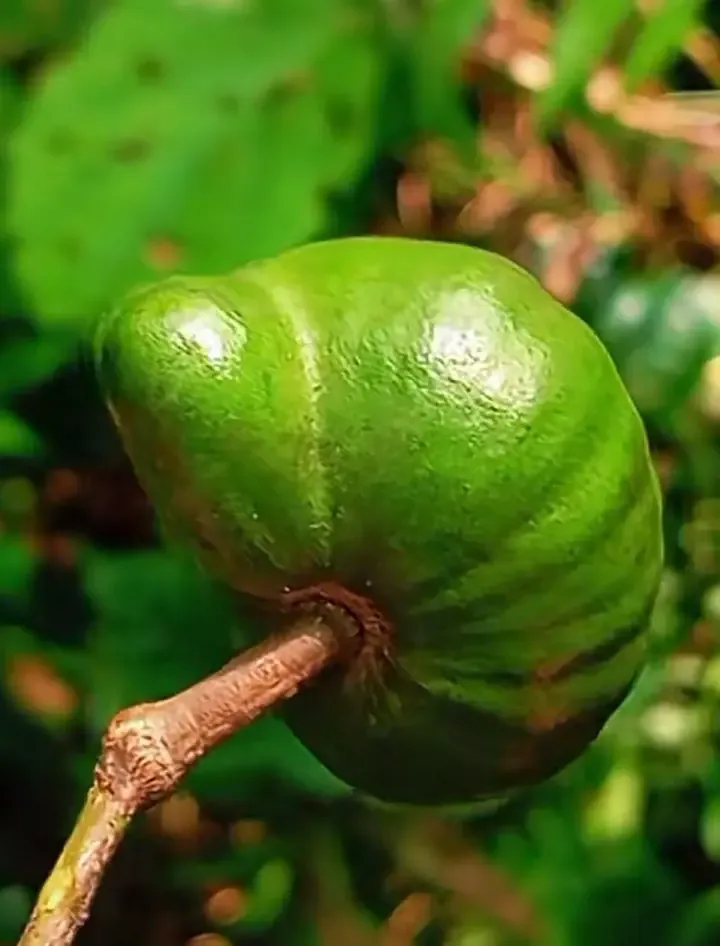
Genuine Rudraksha grows in three regions with three distinct characters — Nepal (large beads, deep defined faces), Indonesia and Java (small, light, shallow-lined), and India. The differences, and what they mean for price and use, have their own honest guide.
Mukhi — the grammar of the bead
Run a thumb over any Rudraksha and you will feel the clefts — complete natural grooves running from the stalk hole to the base. Each complete groove is a mukhi, a face, and the count of faces from 1 to 27 is how the entire tradition organises the beads: each count carries its own deity, planet, and traditional purpose. The 5 Mukhi is the common, universal bead; the round Ek Mukhi is the near-mythical rarity. The full chart — every count, every association — is the reference page of this journal.
Six bands cover the whole 1–27 range. Each bead’s own page shows its US-dollar price by size for buyers outside India and Nepal, and the rarest pieces are quoted one by one against photographs of the actual piece; the table shows where each band sits:
| Count | Rarity & role | Where it sits on price |
|---|---|---|
| 1 Mukhi | The rarest single bead — Shiva himself | Rare-count territory |
| 2 Mukhi | Uncommon; the bead of union | Close to the 1 Mukhi |
| 3–4 Mukhi | Fire and knowledge; readily found | Everyday |
| 5 Mukhi | The universal first bead — most of the harvest | Everyday |
| 6–14 Mukhi | The classical working range | Everyday to moderate, rising steeply at 14 |
| 15–21 Mukhi | Scarce; collector territory begins | Collector — rising with every face |
| 22–27 & Nirakar | A few pieces a season — priced individually | Quoted per piece |
Are Rudraksha beads real?
Botanically, entirely: Rudraksha is a real seed of a real, well-documented tree — not a manufactured object, not a myth. The honest question hiding inside this one is different: is the bead in front of you real? Because genuine Rudraksha commands real prices, the market has produced carved fakes, glued composites, and “upgraded” counts for as long as it has existed. The answer is in the bead itself — natural lines running pole to pole, a woody seed surface, no seams — and the full inspection method is our most-read guide.
As for what the beads do: the tradition assigns them auspiciousness and support for practice, and we sell them on provenance and craft, never as medicine. What an honest seller can prove is what a bead is and where it grew. We prove exactly that.
Who wears Rudraksha, and why
Everyone the tradition can name: sadhus and students, householders and monks, women and men and children, Hindus and people of every faith and none. The path asks no initiation, and tradition holds the 5 Mukhi in particular suitable for everyone, without condition. People wear Rudraksha to accompany a meditation practice, to mark an intention, to carry a tradition their family carries — and increasingly, in the West, simply as the original meditation bead, older than every alternative on the shelf. How to begin wearing one, and the rules that actually matter, are covered step by step in the wearing guide.
Frequently asked questions
What is rudraksha called in English?
It has no separate English name: in English it is simply called rudraksha (also spelled rudraksh). The word is Sanskrit — Rudra (Shiva) and aksha (eye) — which is why it is often explained as “Shiva’s tears”. Botanically it is the seed of Elaeocarpus ganitrus, occasionally called the utrasum bead tree in older English references.
What is Rudraksha in simple words?
Rudraksha is the dried stone of the fruit of the Elaeocarpus ganitrus tree, which grows in the Himalayan foothills; people commonly call it a seed. The ridged seed is worn as a sacred bead and strung into 108-bead malas for mantra meditation. It is held sacred to Lord Shiva in the Hindu tradition.
What does the word Rudraksha mean?
It is a Sanskrit compound of Rudra — a name of Shiva — and aksha, meaning eye or tears: “the eye of Rudra” or “the tears of Shiva”, after the origin story in which the trees rose where Shiva’s tears fell.
Are Rudraksha beads real?
Botanically, yes — Rudraksha is the genuine seed of a real, documented tree species. The practical question is whether a specific bead is genuine, since carved and glued fakes exist; careful inspection of the lines, surface and seams, and photographs of the exact bead before you buy, settle most cases.
How is a Rudraksha formed?
Inside the blue fruit of Elaeocarpus ganitrus is a hard stone divided into compartments, each holding a seed. Where the compartment walls reach the surface a groove runs pole to pole, and those grooves are the mukhi, fixed while the fruit grows on the tree. Our tree and seed guide shows the whole sequence.
What is Rudraksha made of?
Nothing but itself — it is the natural stone of the fruit, often called a seed. The blue fruit flesh is removed after harvest and the stone is cleaned and dried; a genuine bead is never carved, moulded, or assembled.
Why is Rudraksha associated with Lord Shiva?
The Shiva Purana and Rudrakshajabala Upanishad describe the trees rising where Shiva’s tears fell after a long meditation — the name itself means “tears of Rudra”. The beads remain the emblem of Shaiva practice, worn while chanting Om Namah Shivaya.
Where does the best Rudraksha come from?
Tradition prizes the beads of eastern Nepal — the Arun and Tamur valleys — for their size and deep, clearly defined faces. Indonesian beads are genuine but smaller and lighter, suited to dense malas. The origin difference drives most of the price difference.
How do you pronounce rudraksha?
ROO-draak-sha: rudra (Shiva) plus aksha (eye). In Sanskrit it is written रुद्राक्ष, rudrākṣa; in Hindi it is often said and spelled rudraksh.
Is rudraksha the tears of Shiva?
That is the traditional story behind the name: the tree is said to have grown from Shiva’s tears. It is a sacred story rather than botany; the bead is the stone of the fruit of Elaeocarpus ganitrus.
Where to go next
- Mukhi meaning chart (1–27)
- How to identify a real bead
- Check any bead with the authenticity checker
- How to wear Rudraksha
- Browse all Rudraksha
- Rudraksha Bead Size Versus Mukhi Count: Which…
- 5 Mukhi Rudraksha
- 108-Bead Japa Mala
Keep reading
- Shiva Shankalpa Mala — The Most Powerful Rudraksha Combination Explained
- One Mukhi Rudraksha — The Supreme Bead of Lord Shiva
- Why Every Religion Invented Prayer Beads — Rosary, Tasbih, Mala, and the Himalayan Seed
- The Rudraksha Tree and Its Seed — What It Looks Like and How the Bead Forms
- How to Connect with God — A Himalayan Answer to an Ancient Question