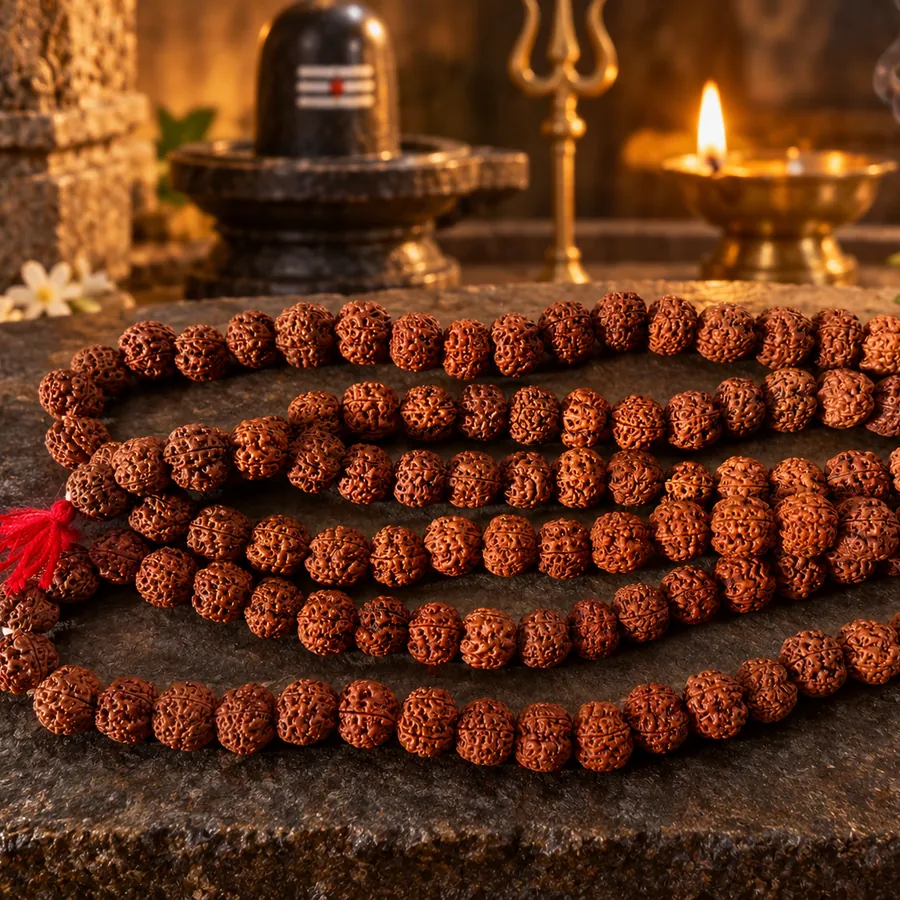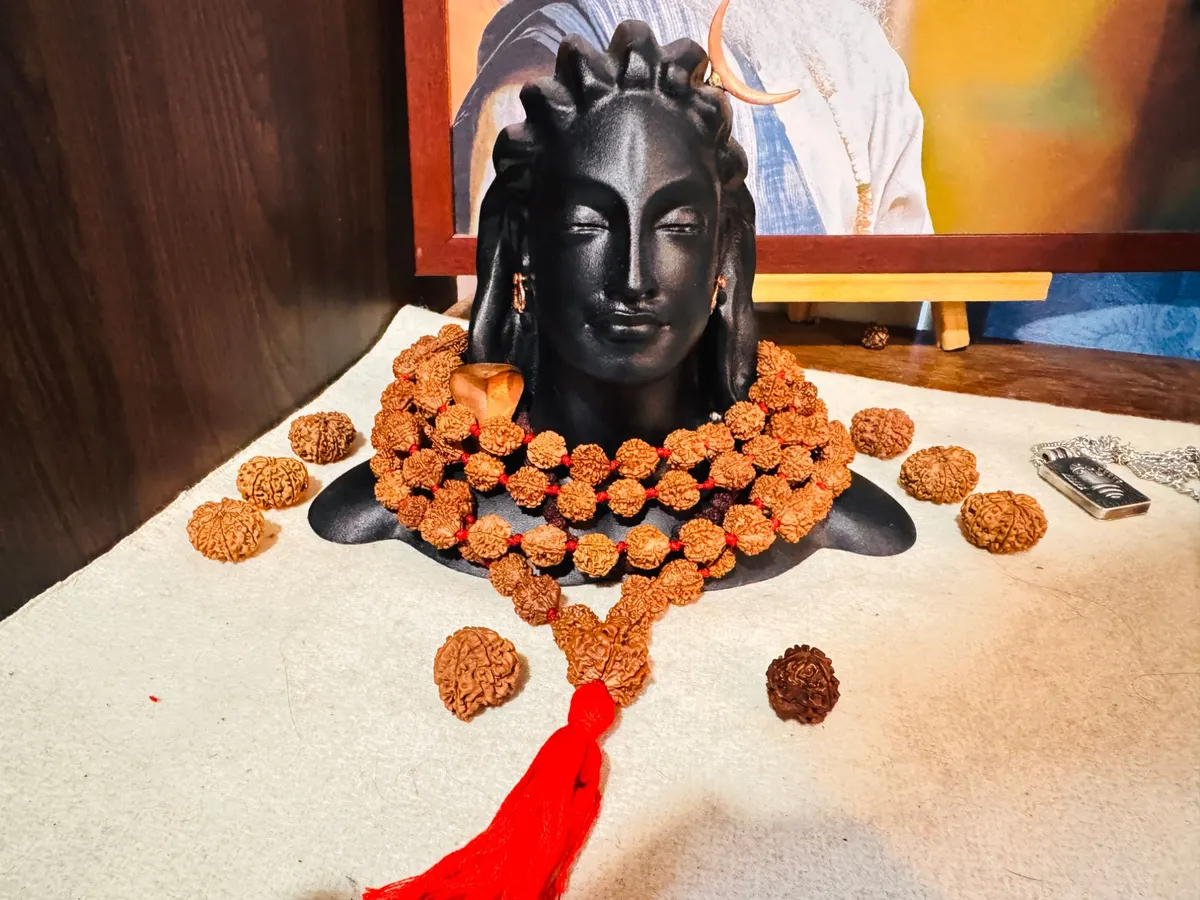
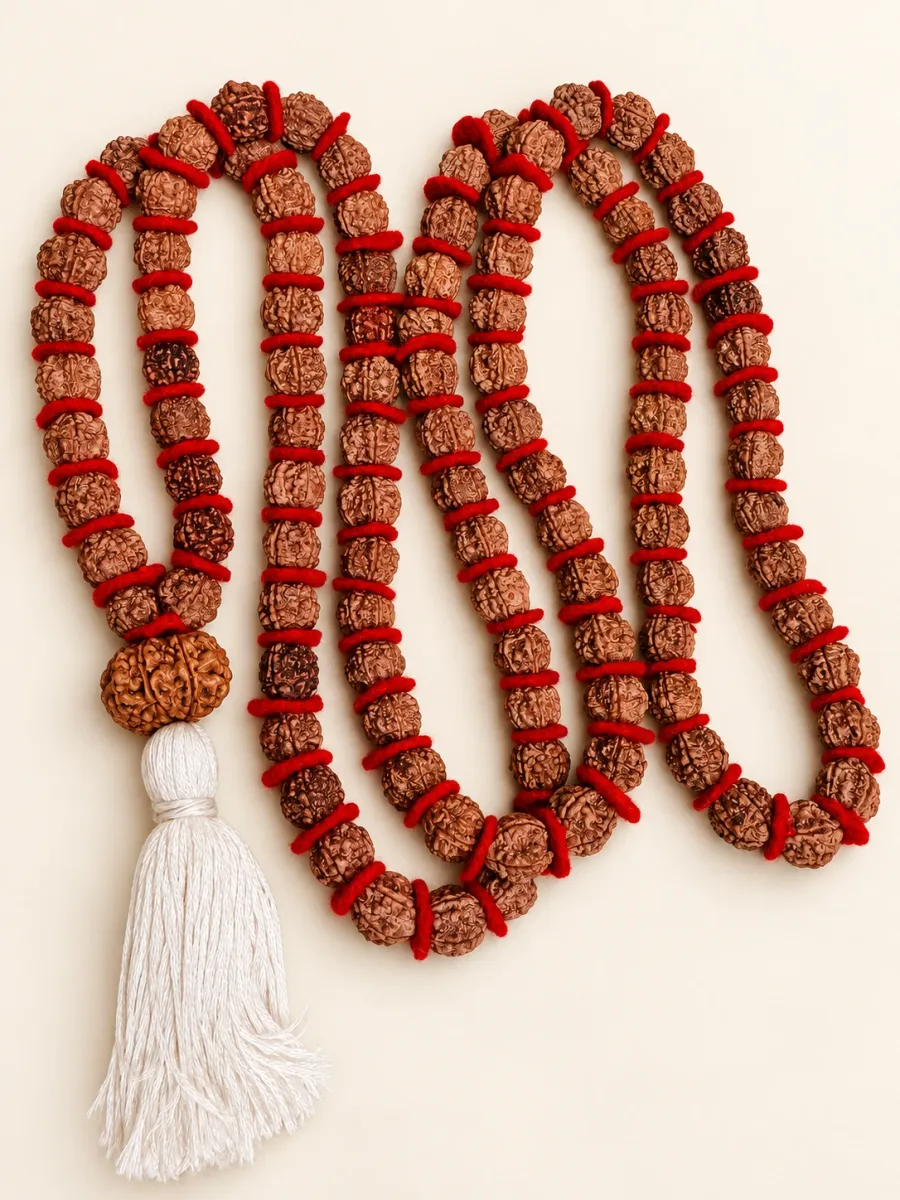
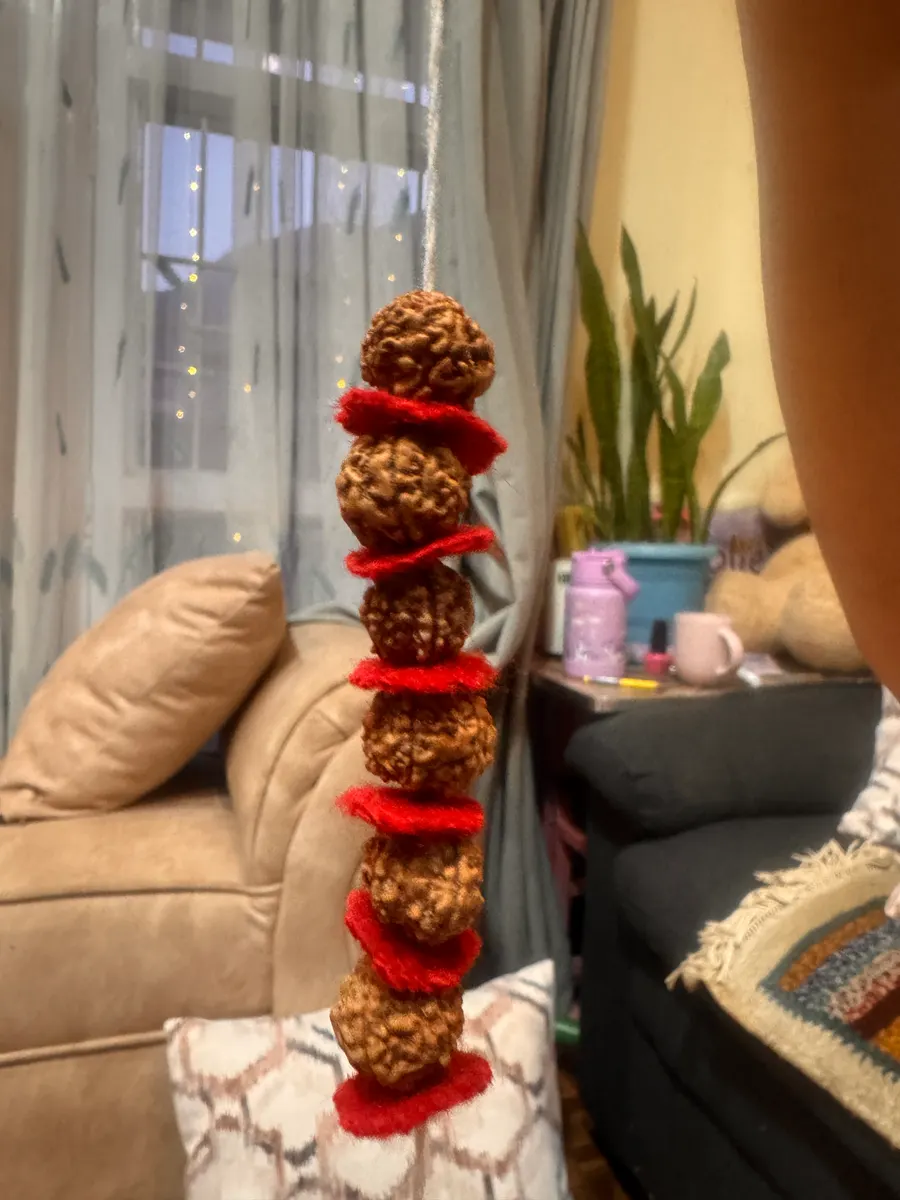
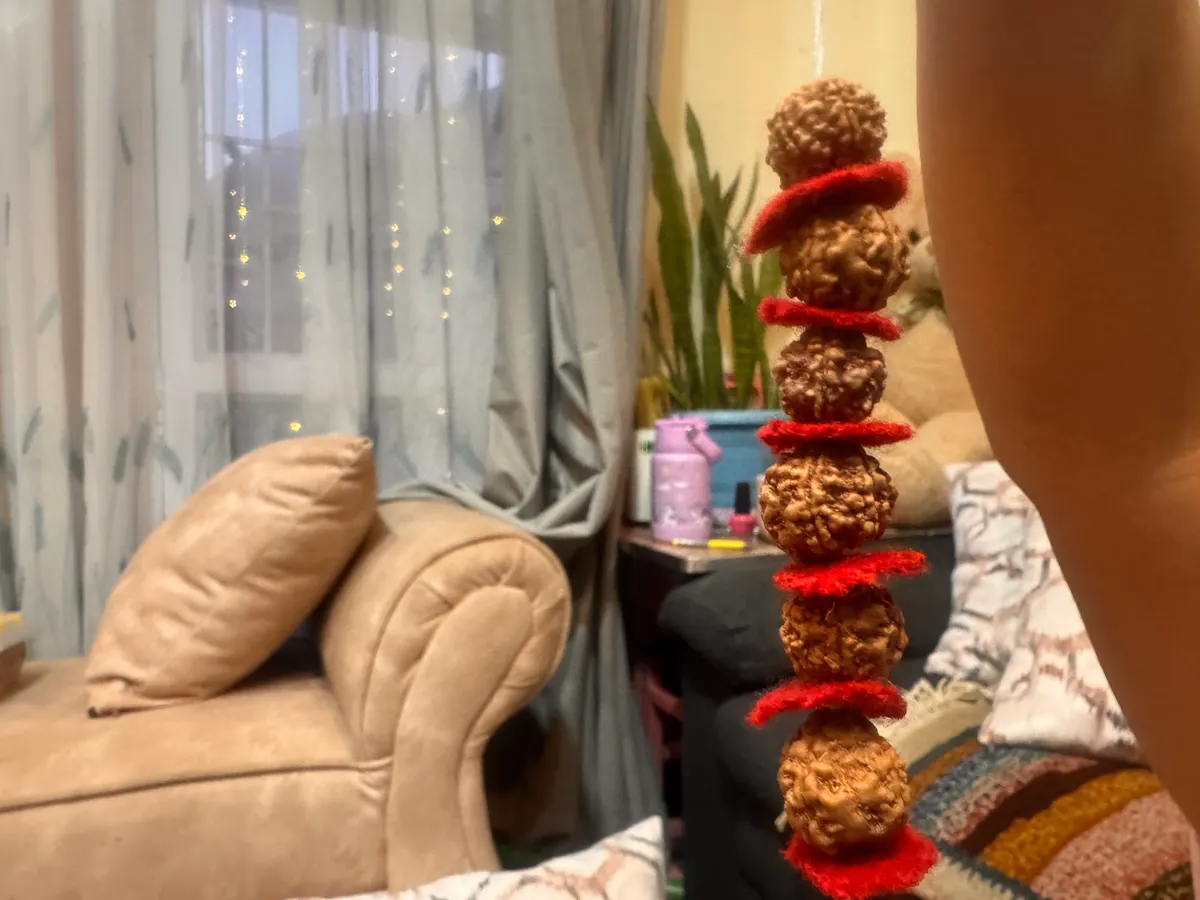
Strung by hand, one bead at a time
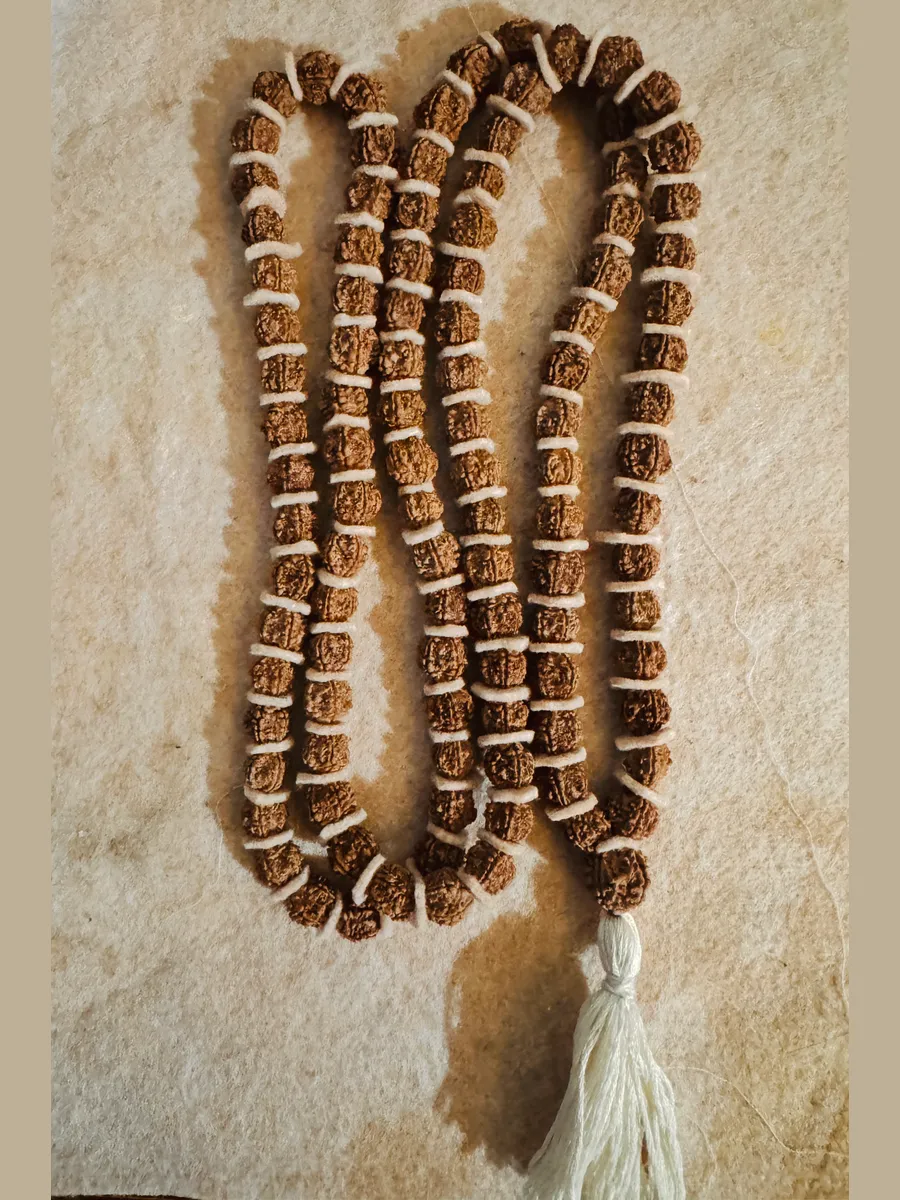
Our own photographs and videos of a Five Mukhi strand being made: each bead is threaded by hand onto cotton cord, with a disc of red wool between it and the next, so the beads do not rub against each other and your fingers find a clear stop at every bead while you count. They show how the work is done, not the exact mala you would receive. Ask, and before you pay we send photographs and video of the exact piece we would send you, not the picture on this page; we always send them before it ships.
5 Mukhi Japa Mala with 9 Mukhi Guru Bead · 10 mm
Rare · 108 small 10 mm Nepali Five Mukhi · a Nine Mukhi guru bead · price on call
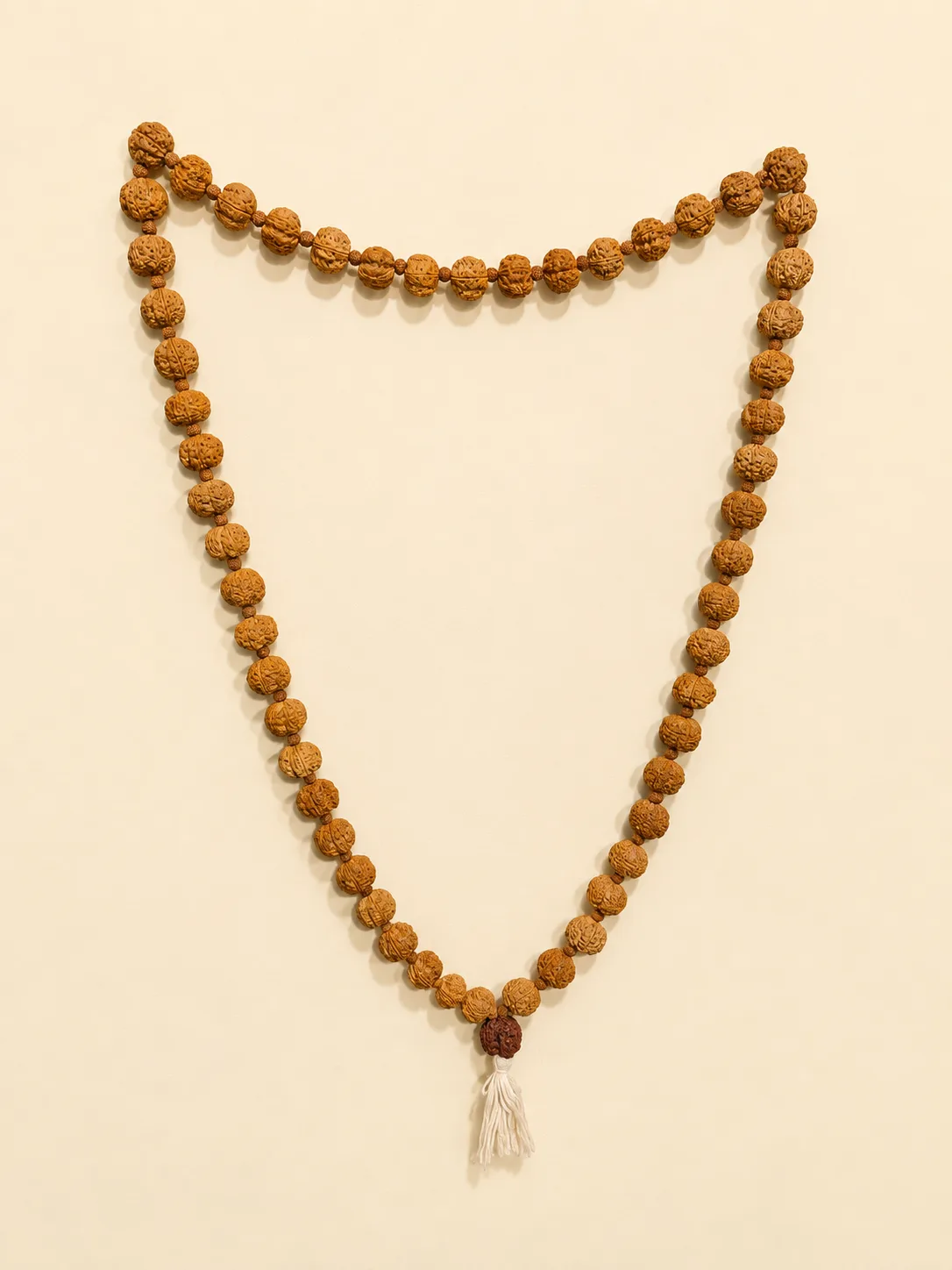
A 108-bead japa mala of small Five Mukhi Nepali rudraksha, about 10 mm each, with red wool between every bead, closed by a large Nine Mukhi rudraksha as the guru bead and a white cotton tassel. The two counts do two different jobs. The 108 Five Mukhi beads are the ones the fingers travel: Five Mukhi is Kalagni Rudra, under Brihaspati (Jupiter), the bead the tradition holds suitable for everyone and the one a japa mala is strung from, associated with calm and a steady mind in daily practice. The guru bead is where every round begins and ends, and here it is a Nine Mukhi: the bead of Durga in her nine forms, under Ketu, traditionally worn for fearlessness, protection and strength through fear, grief or hostile times. So the beads you count are the steady Five, and the bead you return to is Durga’s. Nepali Five Mukhi beads usually grow far larger, so a strand matched at 10 mm is rare and slow to gather, and the Nine Mukhi is an uncommon count of its own. Grown in the Arun Valley of eastern Nepal — Bhojpur, Dingla and Sankhuwasabha — and strung in Kathmandu.
Benefits
- Made for japa: 108 Five Mukhi beads and a Nine Mukhi guru bead — 108 + 1, the count the tradition fixes for mantra repetition.
- The counting beads, Five Mukhi: Kalagni Rudra under Brihaspati (Jupiter), associated with calm, a steady mind and focus in daily practice, and held suitable for every wearer.
- The guru bead, Nine Mukhi: Durga in her nine forms (Navadurga), under Ketu — traditionally the bead of fearlessness, protection and strength through hard times.
- Suits japa to the goddess, at Navaratri or on any day, as well as everyday Om Namah Shivaya.
- Small 10 mm Nepali beads with deeper, sharper clefts than the Indonesian beads most small malas use, so each bead is easy to feel under the thumb and the count stays steady.
- Red wool between each bead keeps them from rubbing and gives the fingers a clear stop; at the guru bead, turn the mala and go back rather than crossing it.
Traditional associations as the texts and living practice hand them down — not medical claims.
Price on request: we reply on WhatsApp with the price and photographs and video of the exact piece we can offer, not the picture on this page. Nothing is charged until you agree.
- Authenticity guaranteeLifetime · written
- Your exact beadPhotos + video · before you pay
- Worldwide shipping3–12 days · tracked · your country
- Answers on WhatsAppAt once, and a person from the shop when you need one
Traditional significance of the 5 Mukhi Japa Mala with 9 Mukhi Guru Bead · 10 mm.
A 108-bead japa mala of small Five Mukhi Nepali rudraksha, about 10 mm each, with red wool between every bead, closed by a large Nine Mukhi rudraksha as the guru bead and a white cotton tassel. The two counts do two different jobs. The 108 Five Mukhi beads are the ones the fingers travel: Five Mukhi is Kalagni Rudra, under Brihaspati (Jupiter), the bead the tradition holds suitable for everyone and the one a japa mala is strung from, associated with calm and a steady mind in daily practice. The guru bead is where every round begins and ends, and here it is a Nine Mukhi: the bead of Durga in her nine forms, under Ketu, traditionally worn for fearlessness, protection and strength through fear, grief or hostile times. So the beads you count are the steady Five, and the bead you return to is Durga’s. Nepali Five Mukhi beads usually grow far larger, so a strand matched at 10 mm is rare and slow to gather, and the Nine Mukhi is an uncommon count of its own. Grown in the Arun Valley of eastern Nepal — Bhojpur, Dingla and Sankhuwasabha — and strung in Kathmandu. Ours come from the Arun and Tamur valleys of eastern Nepal, among them Bhojpur, the hills around Dingla, and Sankhuwasabha, where Nepali beads grow larger and more deeply faced than the Indonesian beads common elsewhere.
Each bead we sell from this catalogue is hand-selected in Kathmandu, photographed under daylight, and sent only on your WhatsApp confirmation. You message us, and you see the exact piece you'll receive before you pay. The spiritual benefits described above reflect traditional Vedic belief; we offer the bead, not the outcome.
How we verify authenticity
- • Visual inspection under daylight by experienced Kathmandu sorters
- • Ridge depth and mukhi-line clarity checked individually
- • Density check — every bead is water-tested as a coarse in-house sort. It is a filter, not proof.
- • Lifetime authenticity guarantee: if an independent laboratory or a recognised authenticity expert finds that a bead we sold is not genuine, we refund it in full, with no time limit. How a claim works
See your own piece before you pay, or before it ships.
We photograph and film the exact item you are buying — mukhi lines traced, both drill holes shown — and send it to you on WhatsApp: before you pay if you ask, and always before dispatch. That is your piece, not the picture on this page. A piece priced on request is quoted against those photographs: nothing is charged until you agree.
If an independent laboratory or a recognised authenticity expert finds in writing that the bead you approved is not genuine, we refund the full amount you paid. No expiry. The terms.
Choose Pran Pratishtha at Pashupatinath and we share photos or video of your own piece at the ritual before it leaves Kathmandu.
About this piece.
What is the importance of this japa mala?
It joins two beads with two different jobs. The 108 small Five Mukhi beads are the counting beads: Five Mukhi is Kalagni Rudra, under Brihaspati (Jupiter), the bead the tradition holds suitable for everyone and the one a japa mala is made from, associated with calm and a steady mind. The guru bead, where every round of 108 begins and ends, is a Nine Mukhi: Durga in her nine forms, under Ketu, traditionally the bead of fearlessness and protection. So the beads you count are the steady Five, and the bead you return to is Durga’s. These are traditional associations, not medical claims or promised outcomes.
What is the power of the 5 Mukhi beads?
In the tradition the Five Mukhi is Kalagni Rudra, Shiva as the fire of time, under Brihaspati, the guru among the grahas. It is associated with calm, general wellbeing and a steady mind for daily practice, and it is the one bead the tradition calls suitable for every wearer, which is why nearly every 108-bead japa mala is strung from it. Small 10 mm Nepali beads carry deep, sharp clefts, so each one is easy to feel under the thumb and the count stays steady with your eyes closed.
What is the power of the 9 Mukhi guru bead?
The Nine Mukhi is the bead of Navadurga, the goddess Durga in her nine forms, set against Ketu. The tradition associates it with fearlessness, protection and strength for anyone walking through fear, grief or hostile times, and it is long linked with the strength of women. As the guru bead it sits at the start and end of every round, so each round of japa begins and closes on Durga’s bead. Our 9 Mukhi benefits page has the full account.
Why is the guru bead a 9 Mukhi and not a 5 Mukhi?
The guru bead (the sumeru or bindu) is not counted; it marks where a round begins and ends, so it is often a larger or different bead from the 108. Most malas close on a larger Five Mukhi. This one closes on a Nine Mukhi, which brings Durga’s bead of fearlessness and protection to that place beside the Five Mukhi’s calm. It suits japa to the goddess, at Navaratri or any day, and everyday Om Namah Shivaya alike.
How do I use this mala for japa?
Take the mala in the right hand, draped over the middle finger, and keep the index finger off the beads. Begin at the bead beside the Nine Mukhi guru bead: one repetition of the mantra, then the thumb draws the next bead toward you. Om Namah Shivaya is the mantra for every rudraksha; for japa to Durga, use the mantra your teacher or family gives you. Back at the guru bead one round of 108 is complete; to continue, turn the mala and travel back rather than crossing the guru bead.
Is this an original Nepali mala?
Yes. The Five Mukhi beads and the Nine Mukhi guru bead are Nepali rudraksha from the Arun and Tamur valleys of eastern Nepal — among them Bhojpur, Dingla and Sankhuwasabha — and the mala is strung in Kathmandu. Ask on WhatsApp before you pay and we photograph and film the strand you will receive, in daylight, so you can count the faces on the beads, the guru bead’s nine included, yourself. It carries our lifetime authenticity guarantee: if it is ever found not genuine, in writing, by an independent laboratory or a recognised authenticity expert, we refund the full amount you paid.
Can this 5 Mukhi Japa Mala with 9 Mukhi Guru Bead · 10 mm be energized at Pashupatinath before shipping?
Yes. On request we complete the Pran Pratishtha ritual — energization, or consecration, what the tradition calls abhimantrit — at the Pashupatinath temple complex before dispatch, and share photos or video of your own piece at the ritual.
Do you ship worldwide, and how long does it take?
Yes — we ship express worldwide from Kathmandu. Message us on WhatsApp with your country and we confirm the delivery window before you pay. Most destinations receive orders within 3–12 days.