The Katha of the 8 Mukhi Rudraksha
Shiva’s tears, and the bead that is Ganesha himself
For a thousand divine years Shiva kept his eyes open, and from his tears the rudraksha trees were born. Of the eight-faced bead he tells Kartikeya: it is Vinayaka himself.
In the Devi Bhagavata Purana, Kartikeya, whom his father calls Mahasena, asks about the greatness of the rudraksha. Shiva answers with how the bead came to be.
To destroy the three cities of Tripura and free the gods, he says, he fixed his mind on the Aghora weapon, the pacifier of every obstacle. For a thousand divine years he kept his eyes open, never closing them. Then, from his weary eyes, drops of water fell to the earth.
From those tears the great rudraksha trees were born, at his command, for the good of all beings. That is the story of every rudraksha.
Then he speaks of the faces one by one, and of the eight-faced bead he says: O Mahasena, it is Lord Vinayaka himself. Ganesha, the remover of obstacles, honoured first in every rite.
The Shiva Purana gives the same bead two more names: Vasumurti, and Bhairava, the fierce form of Shiva himself.
देवीभागवत में कार्तिकेय (महासेन) अपने पिता महादेव से रुद्राक्ष की महिमा पूछते हैं। शिव बताते हैं कि त्रिपुर के वध और देवताओं के उद्धार के लिए उन्होंने अघोर अस्त्र का ध्यान किया। एक हज़ार दिव्य वर्षों तक उनके नेत्र खुले रहे, और फिर उनके नेत्रों से जल की बूँदें धरती पर गिरीं।
उन्हीं आँसुओं से, सबके कल्याण के लिए, महान रुद्राक्ष के वृक्ष उत्पन्न हुए। फिर शिव कहते हैं: हे महासेन, आठ मुखों वाला रुद्राक्ष साक्षात् भगवान विनायक हैं।
शिवपुराण में आठमुखी रुद्राक्ष को वसुमूर्ति और भैरव कहा गया है।
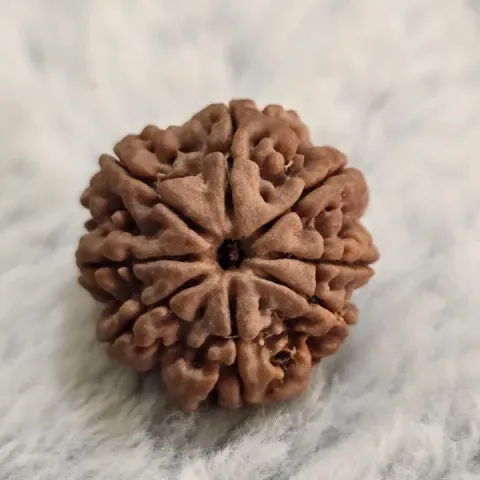
Vinayaka in the Devi Bhagavata Purana; Vasumurti and Bhairava in the Shiva Purana.
- देवीभागवत · ११.४.७–८Devi Bhagavata Purana 11.4.7–8
दिव्यवर्षसहस्रं तु चक्षुरुन्मीलितं मया ।पश्चान्ममाकुलाक्षिभ्यः पतिता जलबिन्दवः ॥ ७ ॥तत्राश्रुबिन्दुतो जाता महारुद्राक्षवृक्षकाः ।ममाज्ञया महासेन सर्वेषां हितकाम्यया ॥ ८ ॥
divyavarṣasahasraṃ tu cakṣur unmīlitaṃ mayā · paścān mamākulākṣibhyaḥ patitā jalabindavaḥ · tatrāśrubindu-to jātā mahārudrākṣavṛkṣakāḥ · mamājñayā mahāsena sarveṣāṃ hitakāmyayā
For a thousand divine years I kept my eyes open; then from my weary eyes drops of water fell. From those teardrops the great rudraksha trees were born, by my command, O Mahasena, for the good of all.
- देवीभागवत · ११.४.१७Devi Bhagavata Purana 11.4.17 (second half)
अष्टवक्त्रो महासेन साक्षाद्देवो विनायकः ॥
aṣṭavaktro mahāsena sākṣād devo vināyakaḥ
O Mahasena, the eight-faced one is Lord Vinayaka himself.
- शिवपुराण · विद्येश्वरसंहिता २५.७३Shiva Purana, Vidyeshvara Samhita 25.73
रुद्राक्षश्चाष्टवक्त्रश्च वसुमूर्तिश्च भैरवः ।धारणात्तस्य पूर्णायुर्मृतो भवति शूलभृत् ॥
rudrākṣaś cāṣṭavaktraś ca vasumūrtiś ca bhairavaḥ · dhāraṇāt tasya pūrṇāyur mṛto bhavati śūlabhṛt
The eight-faced rudraksha is Vasumurti and Bhairava. By wearing it one lives a full span of life, and after death becomes the trident-bearer.
That is the verse’s own promise, in the language of scripture. We offer the bead, not the outcome.
- Devi Bhagavata Purana, Book 11, chapter 4: verses 1–8 (the origin of rudraksha from Shiva’s tears) and 17 (the eight-faced bead is Vinayaka)
- Shiva Purana, Vidyeshvara Samhita, chapter 25, verse 73 (Vasumurti and Bhairava)
The 8 Mukhi Rudraksha, from Nepal
Eight natural faces, grown in the Arun valley of eastern Nepal. Ask us on WhatsApp and we send photos and a video of your exact bead before you pay.