The Katha of the 7 Mukhi Rudraksha
What Shiva told Kartikeya about the seven faces
Kartikeya asks his father who dwells in the faces of the rudraksha. Of the seven-faced bead, Mahadev answers: Ananta, king of the nagas, and in each of its faces, a naga.
In the Padma Purana, in the chapter on the greatness of the rudraksha, Kartikeya, the six-faced son of Shiva, asks his father which deities dwell in the different faces of the bead. Mahadev answers him face by face.
Of the seven-faced bead he says it is the form of Ananta, the endless one, king of the nagas, on whom the world rests. And in each of its seven faces, he says, a naga abides: Ananta, Karkata, Pundarika, Takshaka, Visholbana, Karisha and Shankhachuda.
In the same chapter Shiva tells of how far the grace of even a fragment reaches. In the land of Maru, the desert country, a merchant was struck by a thunderbolt. Where he fell lay half a rudraksha. By that touch alone, the story says, a divine vimana came to carry him to Shiva’s realm.
The Shiva Purana knows the seven-faced bead by another name. There it is Mahadev who speaks to Parvati, and he calls it Ananga.
पद्मपुराण में कार्तिकेय अपने पिता महादेव से पूछते हैं कि रुद्राक्ष के अलग-अलग मुखों में कौन विराजता है। शिव बताते हैं कि सातमुखी रुद्राक्ष नागराज अनन्त का स्वरूप है। उसके सात मुखों में एक-एक नाग का वास है—अनन्त, कर्कट, पुण्डरीक, तक्षक, विषोल्बण, कारीष और शंखचूड़।
इसी अध्याय में शिव रुद्राक्ष के एक छोटे से टुकड़े की कथा भी सुनाते हैं। मरुदेश में एक व्यापारी पर वज्र गिरा। वह जहाँ गिरा, वहाँ आधा रुद्राक्ष पड़ा था। कथा कहती है कि उस स्पर्श से उसे शिवलोक ले जाने के लिए एक दिव्य विमान आया।
शिवपुराण में महादेव माँ पार्वती से सातमुखी रुद्राक्ष का नाम ‘अनंग’ बताते हैं।
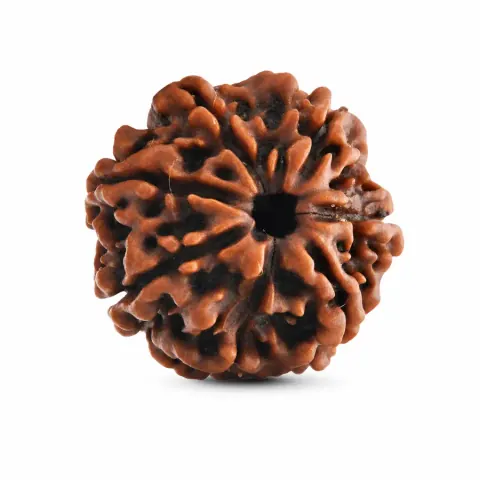
One naga in each face, with Ananta, king of the nagas, as the form of the whole bead.
- पद्मपुराण · सृष्टिखण्ड ५९.१७०–१७१Padma Purana, Srishti Khanda 59.170–171
अस्य प्रत्येक वक्त्रे तु प्रतिनागा व्यवस्थिताः ।अनंतः कर्कटश्चैव पुंडरीकोथ तक्षकः ॥ १७० ॥विषोल्बणश्च कारीषः शंखचूडश्च सप्तमः ।एते नागा महावीर्याः सप्तवक्त्रे व्यवस्थिताः ॥ १७१ ॥
asya pratyeka vaktre tu pratināgā vyavasthitāḥ · anantaḥ karkaṭaś caiva puṇḍarīko ’tha takṣakaḥ · viṣolbaṇaś ca kārīṣaḥ śaṅkhacūḍaś ca saptamaḥ · ete nāgā mahāvīryāḥ saptavaktre vyavasthitāḥ
In each of its faces a naga abides: Ananta, Karkata, Pundarika, then Takshaka; Visholbana, Karisha, and Shankhachuda the seventh. These nagas of great power dwell in the seven-faced bead.
- शिवपुराण · विद्येश्वरसंहिता २५.७२Shiva Purana, Vidyeshvara Samhita 25.72
सप्तवक्त्रो महेशानि ह्यनङ्गो नाम नामतः ।धारणात्तस्य देवेशि दरिद्रोऽपीश्वरो भवेत् ॥
saptavaktro maheśāni hy anaṅgo nāma nāmataḥ · dhāraṇāt tasya deveśi daridro ’pīśvaro bhavet
O Maheshani, the seven-faced one is called Ananga by name. By wearing it, O queen of the gods, even one who is poor may become a lord.
That is the verse’s own promise, in the language of scripture. We offer the bead, not the outcome.
- Padma Purana, Srishti Khanda, chapter 59: verses 169–174 (Kartikeya’s question and the seven nagas) and 203–209 (the land of Maru)
- Shiva Purana, Vidyeshvara Samhita, chapter 25, verse 72 (the name Ananga)
The 7 Mukhi Rudraksha, from Nepal
Seven natural faces, grown in the Arun valley of eastern Nepal. Ask us on WhatsApp and we send photos and a video of your exact bead before you pay.