Curiosities
The Subtle Pull Between Two Rudraksha Beads
A personal observation, the little evidence that exists, and an experiment you can run at home.
By Kathmandu Rudraksha · Published 16 September 2026
What I notice, and what I am not claiming
Rudraksha has been respected for centuries as a companion for prayer, meditation and spiritual discipline. Its name is traditionally understood as “the tears of Rudra,” a name of Lord Shiva. For many people a Rudraksha is not simply a seed or an ornament; it is something worn with reverence and experienced personally.
Over the years I have spoken with Rudraksha farmers, sellers and people who have handled these beads for a long time. In those conversations I noticed something surprising: many of them had never paid close attention to a sensation I get when I bring two beads close together.
I describe it as a gentle pull.
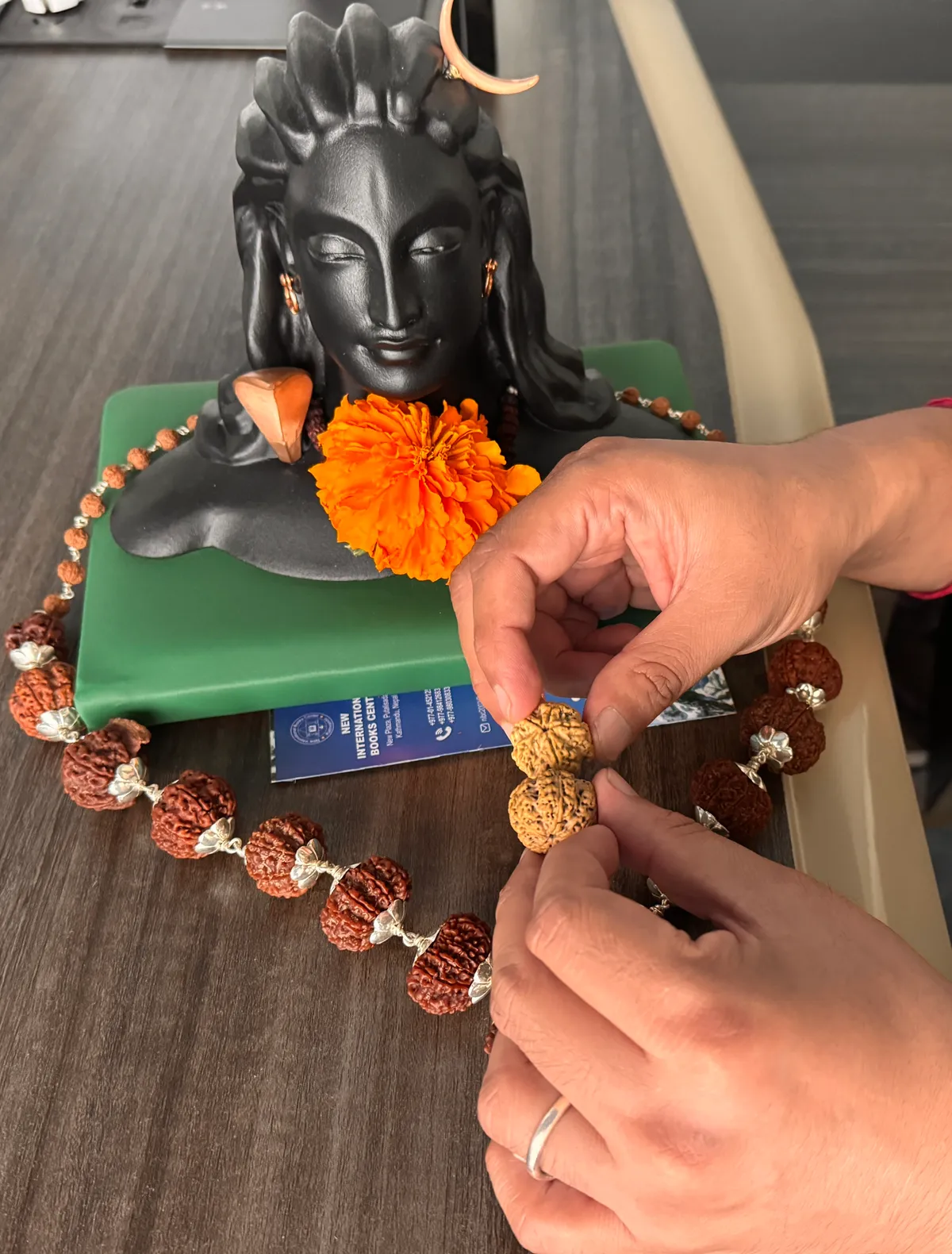
It is not the firm attraction of two ordinary magnets. It is much more delicate. When I hold one bead in each hand, bring them close without pressing them together, relax my fingers and pay attention, I sometimes feel a slight drawing between them. Because the sensation is so subtle, it is easily overlooked — and, I should say plainly, just as easily invented by an expectant hand.
Could Rudraksha have magnetic properties?
There is very little research on this. One published study examined powdered 3, 4 and 5 mukhi Rudraksha using sensitive laboratory equipment — a vibrating sample magnetometer, SQUID magnetometry and electron paramagnetic resonance spectroscopy. The researchers reported weak ferromagnetic behaviour in the tested samples and suggested trace mineral content may account for it.
That is interesting, and it should be read carefully. The samples were cleaned, dried and ground to powder, measured under controlled conditions, with external magnetic fields applied. The study did not test whether two intact beads attract each other strongly enough for a person to feel. It did not establish that magnetic behaviour produces any health benefit, or that it makes a bead spiritually “active”. Its own authors called for further research.
It is also a single small paper in a low-impact journal, and as far as we can find, nobody has replicated it. One study is a reason to stay curious. It is not a finding to build a sales claim on, and we are not building one. Our wider survey of what the research does and does not show is in the scientific research guide.
What else could produce the sensation
When two light, deeply grooved seeds are held very close, several small effects can influence what the hand reports. Tiny involuntary finger movements. Gravity. Air movement. Surface friction and the interlocking of natural ridges. Moisture on the skin. Static charge. And the expectation of movement, which is the strongest of them and the hardest to feel working.
More than one of these can be present at once. That does not mean the experience should be dismissed — it means personal experience and scientific proof are different kinds of knowledge. A sincere observation is a good beginning for a question. The next step is to put the question in a form somebody else can repeat.
A simple experiment you can run
If you would like to examine the sensation for yourself, the whole task is to remove your own hands from the result:
- Choose two dry, untreated beads and note their mukhi, size and weight.
- Hang each from its own length of thin, non-metallic thread, so that nothing is touching the beads.
- Close the windows and turn off any fan.
- Let both beads come completely to rest, then bring their resting positions close without letting them touch.
- Repeat several times, changing the orientation of the beads between runs.
- Run the same test with two wooden beads of similar size and weight as a control.
- Have somebody else set up each run without telling you which pair is in use, and write down what you observed before you look.
A real magnetic interaction would be repeatable, would happen with no finger pressure at all, and would differ consistently from the control. Filming the runs on a fixed camera helps separate movement that happened from movement the hands believed they felt.
Is the pull a test of authenticity?
No — and I would be wary of anyone selling it as one. Even if a genuine bead does hold trace magnetic minerals, that does not mean every genuine bead will produce a pull you can feel, and it does not mean a carved or joined bead could never imitate the effect. A test that can fail on a real bead and pass on a false one is not a test.
Authenticity is judged by layers of ordinary evidence instead: sourcing you can trace, the natural mukhi lines and surface examined under magnification, and — for a rare or expensive bead — an independent laboratory report using imaging such as X-ray or CT to read the internal structure against the external lines. A certificate should identify the individual bead, with photographs, measurements and a report number somebody can verify. How that works in practice is set out in how rudraksha is tested, and what to look at with your own eyes is in how to identify real rudraksha.
The subtle pull may be an interesting personal check, or a subject worth experimenting on. It is not authentication, and it should not be sold as authentication.
Reverence and curiosity can share a table
Rudraksha belongs to a living tradition. Its value cannot be reduced to a laboratory number — and equally, a laboratory measurement should not be stretched into a claim it never made. Both can be held honestly at once.
For a devotee, holding a bead with stillness and attention is itself a moment of meditation. For a researcher, the same moment raises questions about mineral composition, static charge, magnetic susceptibility and human perception. One approach seeks meaning, the other seeks measurement. They are not in conflict.
My purpose in writing this is not to announce a conclusion. It is to invite attention. Take two beads, become still, bring them close and observe. If you feel a pull, write down what happened. Repeat it. Compare it against something that should do nothing. Stay open both to the mystery of personal experience and to the discipline of honest testing.
Perhaps the sensation will one day be explained completely. Until then it remains a fascinating observation — and an invitation to approach Rudraksha with reverence, patience and an open mind.
Sources and a note
- Sharma, S., Rai, D. V., and Rastogi, M. (2019). “Magnetic Characteristics of Different Mukhi Rudraksha Beads: A Comparative Analysis.” International Journal of Scientific & Technology Research, December 2019.
- Kew Science, Plants of the World Online, which treats Elaeocarpus ganitrus — the name in ordinary trade use, including on this site — as a synonym of the accepted name Elaeocarpus sphaericus.
This article describes a personal observation and discusses preliminary research. It does not claim that Rudraksha prevents, diagnoses or treats any medical condition, and the perceived pull between two beads should not be treated as proof of authenticity or of spiritual potency.
Frequently asked questions
Do two real Rudraksha beads attract each other?
Some people, including me, report a faint drawing sensation when two beads are held close. It has never been demonstrated under controlled conditions, and ordinary causes — finger movement, air, friction, static, expectation — can produce the same feeling. Treat it as an open question, not a property of the bead.
Is Rudraksha magnetic?
One small study found weak ferromagnetic behaviour in powdered 3, 4 and 5 mukhi samples under laboratory conditions, and suggested trace minerals as the cause. It has not been replicated, and it did not test whether whole beads attract one another perceptibly.
Can I use the pull test to check whether a bead is genuine?
No. It can fail on a genuine bead and it could be imitated on a false one, which makes it useless as a test. Use sourcing, magnified examination of the mukhi lines, and an X-ray report for rare or costly beads.
How do I test the sensation properly at home?
Hang each bead on its own thin non-metallic thread so your hands never touch them, still the air, let them come to rest, and compare against two wooden beads of similar size. Have somebody else choose which pair is used, and film it.
Does a stronger pull mean a more powerful bead?
There is no evidence for that, and we would not make the claim. Nothing in the research links magnetic behaviour to spiritual potency or to any health outcome.
Why do many sellers and farmers not mention this?
Most of the people I have asked had simply never tried it. The sensation is faint enough that it goes unnoticed unless you are still, unhurried and looking for it.
Where to go next
- What research shows
- How rudraksha is tested
- How to identify real rudraksha
- All Mukhi Rudraksha
- Wearing a Rudraksha That Belonged to Someone Else
- 5 Mukhi Rudraksha
- 108-Bead Japa Mala